Tag: AI filmmaking

  • How to Win an AI Film Competition: The Complete Director’s Playbook

    How to Win an AI Film Competition: The Complete Director’s Playbook

    Most submissions to an AI film competition fail in the first ten seconds. The opening shot reveals a melting hand, a character whose face shifts between cuts, or a generic slow-motion drone glide over an imaginary cyberpunk city. The audio is an unmixed stock track that drowns out flat synthetic narration.

    Judges screen hundreds of submissions over a single weekend. They do not grade on the raw novelty of prompting a diffusion model. By 2026, anyone can type an ambitious prompt into Kling, Runway, or Sora and spit out five seconds of 4K spectacle. Visual ambition without story structure is white noise.

    To win an AI film competition, you have to direct the machine instead of letting the machine direct you. Winning films demonstrate narrative coherence, strict continuity, intentional camera grammar, and professional sound design. Here is the exact playbook to move your project from the submission pile to the awards podium.

    What do judges actually look for in an AI film competition?

    Judges evaluate four core pillars when scoring entries:

    1. Story and emotional resonance (40%): Does the short have a clear dramatic arc? Is there a protagonist with a concrete goal and real stakes? A ninety-second short that makes the audience feel tension or grief beats a three-minute tech demo every time.
    2. Character and visual continuity (25%): Can you hold the same character across three distinct angles and lighting setups? If your lead actor swaps bone structure between shots, you lose points immediately.
    3. Cinematic intent and camera grammar (20%): Did you pick camera moves that serve the emotion of the scene, or did you accept whatever random panning motion the generative model gave you? Every pan, push, and Dutch angle must feel deliberate.
    4. Sound design and audio mixing (15%): Bad audio ruins good video. Festivals demand dedicated Foley, ambient room tone, balanced dialogue, and custom scoring that hits cut points cleanly.

    If you want to test how your work holds up under pressure before submitting to a major festival, enter the Kodex1 Coliseum. Coliseum rounds pit creators against timed prompts and live community voting, giving you immediate feedback on what grips an audience.

    How long should an AI competition film be?

    Keep your film between 60 and 120 seconds. Unless a festival brief specifically demands a longer piece, tighter is always better.

    Festival jurors spend long hours reviewing submissions. A tight, punchy 90-second film maintains pacing and hides the micro-artifacts inherent to generative models. When you stretch an AI short past three minutes without a massive budget and full VFX cleanup, generative fatigue sets in. The audience starts noticing rubbery limbs, drifting eye lines, and unnatural background motion. Pack your story into two minutes max.

    Can you use multiple AI tools in one film?

    Yes. Winning directors never rely on a single generative model. They build a multi-tool pipeline that plays to each platform’s strengths:

    • Character generation and base keyframes: Midjourney v6, Flux.1, or Stable Diffusion for consistent character turnarounds and lighting reference sheets.
    • Action and complex physics: Kling 1.5/2.0 for heavy physical interaction, fabric dynamics, and reliable facial retention during movement.
    • Camera control and stylized VFX: Runway Gen-3 Alpha for precise camera motion brushes, directional pans, and controlled pacing.
    • Environment and cinematic scale: Google Veo or Luma Dream Machine for architectural wide shots and atmospheric establishers.
    • Post-production conform: DaVinci Resolve or Adobe Premiere for edit assembly, color grading, speed ramps, and frame interpolation.
    • Audio and voice synthesis: ElevenLabs for voice acting, paired with sound design tools and manual DAW mixing.

    Judges respect a clear production breakdown. Disclose your stack openly in your project notes. Demonstrating that you directed four different engines into one cohesive visual style proves you are a director, not a prompt passenger.

    The 6-step workflow to win an AI film competition

    1. Write for generative constraints

    Do not write an action scene requiring ten characters wrestling in a crowded market unless you want to spend three weeks rotoscoping. Write scripts that leverage what generative models do well:

    • Solo protagonists or two-hander dialogues.
    • Atmospheric, high-concept environments (sci-fi ruins, isolated research outposts, surreal historical settings).
    • Visual metaphors where slight physical uncanny valley adds psychological weight rather than breaking immersion.

    2. Lock your character bible before generating video

    Create a master character sheet with 6 to 10 distinct angles, neutral expressions, and consistent lighting in your still image generator. Use these reference images as seed frames for image-to-video generation.

    When running generations in Kling or Runway, keep the character’s core wardrobe constant. High-contrast jackets, distinctive hats, or specific glasses help anchor viewer recognition even when the engine shifts subtle facial geometry.

    3. Direct the cut, not just the prompt

    Amateur entries string together ten unrelated beauty shots. A professional short relies on classic cinematic coverage:

    • Establishing shot: Sets geography and mood.
    • Medium shot: Introduces the character action.
    • Over-the-shoulder / Close-up: Establishes emotional stakes and eye contact.
    • Cutaway / Detail shot: Hides transitions and builds tension.

    If a generated clip glitches on second four, cut on second three. Use hard cuts on motion rather than cross-dissolves. Cross-fading between two AI clips screams amateur reel.

    4. Build a tactile soundscape

    Generative video has no weight until sound hits it. Mute all native audio outputs from video generators.

    Layer your sound in a proper timeline:
    1. Sub-bass and room tone: Low rumbles, air conditioner hums, wind pressure.
    2. Foley: Footsteps, cloth rustling, leather creaks, breathing.
    3. Diegetic sound: Mechanical clicks, rain hitting glass, engines idling.
    4. Score: Subtle melodies that avoid drowning out narrative dialogue.

    5. Color grade to unify multiple models

    If shot one came from Kling and shot two came from Runway, the color science and black levels will clash. Bring your complete sequence into DaVinci Resolve or Premiere. Apply a unified film emulation LUT, balance your shadows, and add a fine 35mm film grain overlay across the entire timeline. Grain acts as visual glue, binding disparate AI generations into one photographic world.

    6. Submit early and verify technical specs

    Never submit five minutes before the deadline. Export your master in ProRes 422 or pristine H.265/H.264 matching the competition’s exact aspect ratio (usually 16:9 or 2.39:1 anamorphic). Check your audio loudness levels: aim for -14 LUFS for web-streamed festivals and -24 LKFS for broadcast-spec screenings.

    Where to submit your AI film in 2026

    Once your short is polished, enter these key competitions:

    • Runway AI Film Festival (AIFF): High industry visibility, major cash prizes, and theatrical screenings in New York and Los Angeles.
    • Curious Refuge Competitions: Regular genre-specific challenges with substantial creative community engagement.
    • AI for Good Film Festival (Geneva / United Nations): Focuses on global challenges, ethics, and humanitarian storytelling.
    • Independent FilmFreeway AI categories: Traditional film festivals like Fantasia, Sitges, and regional festivals increasingly host dedicated generative short categories.

    Build a permanent home for your winning work

    Winning an award or landing a finalist spot gives you a temporary spike in visibility. But social media feeds bury your achievement within 48 hours. A Discord link or a tweet does not build a career.

    Professional creators need a permanent studio where scouts, producers, and brands can review their full catalog. Set up your channel on Kodex1 Directors. Kodex1 gives AI filmmakers dedicated studio portfolios with custom URLs, verified badges, and direct client commission tools.

    When you have a body of work ready for monetization, check Kodex1 Earn to see how directors sell licenses, monetize film tickets, and take on paid commercial briefs.

    Ready to test your skills?

    Stop waiting for the next annual festival deadline. Sharpen your storytelling instincts, master rapid turnaround briefs, and compete for cash right now. Head over to Kodex1 and take your place in the arena.
  • What Is Generative Cinema? The New Medium Rewriting How Films Get Made

    What Is Generative Cinema? The New Medium Rewriting How Films Get Made

    What Is Generative Cinema? The New Medium Rewriting How Films Get Made

    Meta description: Generative cinema is the emerging art form where AI models produce film sequences under human direction. Here's what it is, how it works, and why it matters in 2026.


    A new category of filmmaking is taking shape. It does not come from Hollywood. It does not require a crew, a location, or a camera. It requires a director who understands machines, knows what to ask for, and has the creative judgment to turn synthetic output into something that feels like cinema.

    That is generative cinema.

    The term gets used loosely across Discord, X, and Reddit threads, often as a synonym for "AI video." But generative cinema is a more specific thing. Understanding what separates it from AI-generated content in general matters. Both for creators trying to position their work and for audiences trying to understand what they are watching.


    What Is Generative Cinema?

    Generative cinema is the practice of creating films using AI models as the primary production tool, where a human director makes the key creative decisions: narrative structure, visual language, pacing, character consistency, and emotional arc.

    The word "generative" refers to the underlying technology. Neural network models that generate new video output from text prompts, reference images, or motion conditioning. Tools like Kling, Runway, Luma Dream Machine, Veo, and Sora are the instruments. The director is the person who decides what those instruments produce and how the results get assembled into a coherent work.

    This is the crucial distinction. Running a prompt and exporting whatever the model outputs is not generative cinema. It is AI-generated content. Generative cinema requires the same intentionality as any other form of directing: visual decisions, storytelling choices, and the judgment to know when a take works and when to go again.

    The Brooklyn Rail described a generative film as one that "takes advantage of the modularity digital enables". Where the director shapes the material into something deliberate, not just what the tool defaults to. That framing captures it well.


    How Does Generative Cinema Work?

    The Production Stack

    A generative cinema production uses AI video models as its camera, lighting, and special effects department combined. The typical workflow looks like this:

    1. Script and shot design. The director writes a narrative and breaks it into shot-level prompts. Each prompt describes a scene, camera angle, mood, and visual style. Strong prompt writing is a craft skill unto itself.

    2. Generation and iteration. The director runs each shot through one or more AI models. Tools like Kling excel at character consistency and cinematic motion. Runway offers precise motion control. Veo produces high-resolution output. Most serious directors use multiple tools across a single project, picking the best output per shot.

    3. Curation and editing. Each model generates multiple candidates for each shot. The director selects the best takes, the same way a traditional director reviews dailies. What you do not pick matters as much as what you do.

    4. Post-production. Selected shots get assembled in editing software. Sound design, music, color grading, and pacing are all applied by hand. The AI generates the raw material; the director constructs the film.

    What Makes It Cinema vs. Content

    The difference between a generative film and an AI clip is editorial intent. A generative film has a beginning, middle, and end. It has a visual language the director chose deliberately. It makes the audience feel something specific.

    Most AI video content circulating on social media does not meet that bar. It is impressive technically but does not function as cinema. Generative cinema directors are building toward a higher standard. One that can hold up in a real screening context.


    Is Generative Cinema the Same as AI Filmmaking?

    Broadly, yes. The terms are often used interchangeably. But "AI filmmaking" tends to describe any use of AI in a production pipeline, including Hollywood studios using AI for VFX cleanup, de-aging, or digital extras. Darren Aronofsky described this use at Cannes 2026 as "AI as creative infrastructure."

    Generative cinema is more specific: it refers to productions where AI models are the primary image-making tool, not a post-production enhancement. A film where every frame came from a generative model is generative cinema. A blockbuster that used AI to remove a background element is not.

    The distinction matters for creators because it defines the competitive landscape. You are not competing with $200 million studio productions. You are building a new medium alongside other directors at the frontier of a craft that is months old in any serious form.


    Why Does Generative Cinema Matter in 2026?

    The Cost Barrier Collapsed

    Traditional short film production carries a floor cost of several thousand dollars minimum. Camera rental, location fees, crew, actors, post-production. That barrier filtered out a lot of creative voices that simply could not afford to make work.

    Generative cinema collapsed that floor. A director with a subscription to one or two AI video tools can produce a cinematic short for the cost of those subscriptions. The constraint shifts from money to creative judgment. Which is exactly the right constraint for the medium to select on.

    A New Canon Is Being Built Right Now

    The first generation of serious generative films is being made today. The directors building their body of work in 2026 are establishing the aesthetic vocabulary, the storytelling grammar, and the critical standards that will define this medium for the next decade.

    Early adopters are not just making content. They are writing the rulebook. That is an unusual position to be in as a creator.

    Institutions Are Starting to Pay Attention

    Adobe commissioned original generative short films at Sundance 2026. AI film festivals are proliferating. Cannes held debates about generative AI at the same event where it banned AI films from competing for the Palme d'Or. Which itself signals that the form is serious enough to generate a policy response.

    The resistance from traditional film institutions is a sign of relevance, not irrelevance.


    What Tools Do Generative Cinema Directors Use?

    The current toolkit includes:

    • Kling. Strong character consistency, cinematic camera motion, excellent for narrative sequences
    • Runway. Precise motion control, style consistency, widely used for commercial-grade output
    • Luma Dream Machine. Fast generation, good for wide shots and environmental sequences
    • Veo. High resolution output from Google, competitive on visual quality
    • Sora. OpenAI's model, known for long-form coherence across a shot
    • Hailuo. Emerging tool with competitive quality at lower cost

    Most professional generative directors use several tools, selecting per scene based on what each model handles best. There is no single best tool. There is only the right tool for the shot.

    Sound design, music composition (including AI music tools), and editing software round out the stack. The best generative films integrate all of these deliberately.


    Where Does a Generative Cinema Director Build Their Portfolio?

    This is where the infrastructure question becomes practical. Discord servers lose your work. X pushes your best films off the feed in 24 hours. YouTube was not built for the format and its monetization policies are increasingly hostile to AI-generated content.

    Kodex1 is built specifically for this. Directors who upload three or more original AI films (20 seconds or longer each) get a permanent Director Studio. A public portfolio page where their work is showcased, searchable, and connected to a direct hire mechanism for custom commissions. Work does not disappear. Rates are director-set. The audience is built specifically around AI cinema.

    The competitive layer runs through The Coliseum. Battle rounds where directors submit work against a prompt, the community votes, and cash prizes go to the winner. Current and recent rounds have paid $100 to $200 per battle. It is designed for directors who take the craft seriously and want real feedback from an audience that understands the tools.


    Can You Make a Living From Generative Cinema?

    Yes. Not passively, and not from ad revenue. But actively, through competitions, custom commissions, and download sales of your work.

    Directors who build a visible body of work attract clients looking for AI video production at a quality level most people cannot reach. Brands, game studios, music artists, and agencies all want high-quality generative content and are willing to pay for directors who can deliver it consistently.

    The path is through kodex1.com/earn for directors who want to understand the full monetization framework. Competitions, studio commissions, and what it takes to turn AI filmmaking into an actual revenue stream.


    The Bigger Picture

    Generative cinema is not a trend. It is a medium. Like photography once challenged painting, and digital video once challenged film, generative cinema is staking out territory as a distinct form of visual storytelling with its own rules, its own aesthetic, and its own community of directors building something that did not exist before.

    The question for every serious creator working with AI video tools right now is whether they are treating it as content production or as filmmaking. The ones treating it as filmmaking are the ones building something that will outlast this news cycle.

    If you are in that second group, build your portfolio where the medium lives. Start at Kodex1.

  • Kling vs Sora: Which AI Video Generator Should Directors Use in 2026?

    Kling vs Sora: Which AI Video Generator Should Directors Use in 2026?

    Description

    A no-fluff breakdown of Kling 3.0 vs Sora 2 for AI directors in 2026 — covering physics, native audio, motion control, pricing, and which tool wins for cinematic storytelling.

    Kling vs Sora: Which AI Video Generator Should Directors Use in 2026?

    The Kling vs Sora debate is the most searched question in generative cinema right now — and for good reason. Both tools have rewritten what's possible in 2026. But they do it differently, and picking the wrong one for your workflow costs you time, money, and creative momentum.

    This is not a spec sheet recitation. This is a director's breakdown: what each tool actually does well, where each one breaks, and which one earns a permanent place in your pipeline.


    Table of Contents


    What Is Kling 3.0?

    Kling is a text-to-video and image-to-video model built by Kuaishou, the Chinese tech company behind one of the world's largest short-video platforms. Kling 3.0, released in early 2026, is the current flagship. It runs natively at 4K resolution, generates up to 15 seconds of footage per pass, and introduces an "AI Director" mode that chains up to six distinct shots in a single generation cycle — a genuine leap beyond single-clip outputs.

    Key Kling 3.0 specs (source: Kling.ai):

    • Max duration: 15 seconds per generation (3–15s flexible)
    • Resolution: Native 4K (true diffusion, not upscaled)
    • Frame rate: 30fps standard, up to 60fps
    • Audio: Native multi-lingual lip sync, sound effects, background ambience
    • Character locking: Elements 3.0 — uses video references for 3D identity consistency
    • Pricing: $6.99–$25.99/month subscription tiers

    What Is Sora 2?

    Sora 2 is OpenAI's second-generation video model, released in late 2025. It access through ChatGPT Plus and Pro plans. Sora 2's core identity is physics. The model treats video generation as a "Neural World Simulator" — simulating gravity, fluid dynamics, collision forces, and real-world interaction logic rather than just pattern-matching on training data.

    Key Sora 2 specs (source: AtlasCloud):

    • Max duration: Up to 25 seconds (Pro/storyboard mode)
    • Resolution: 1080p standard; 4K available at enterprise tier
    • Physics: Elite-level — simulates weight, gravity, fluid dynamics, complex collisions
    • Audio: Synchronized dialogue and soundscapes supported
    • Access: Credit-based via ChatGPT Plus (~$20+/month) or Pro
    • Best for: VFX work, action sequences, realistic film-style storytelling

    Kling vs Sora: Visual Quality and Physics

    This is where the tools diverge most sharply.

    Sora 2 owns physics. A basketball hitting a rim behaves correctly. Water splashes refract light the way actual water does. Interactions between objects hold up at high resolution without "hallucinating" momentum. For directors who need the real world to look real — action sequences, documentary-style clips, or anything grounded in physical reality — Sora 2 is still the benchmark.

    Kling 3.0 owns pixels. Its Multi-modal Visual Language (MVL) framework focuses on how things look rather than how they move. Micro-detailing on fabric, skin pores, individual hair strands, and environment-responsive lighting — all handled natively at 4K. Sora 2's standard output tops at 1080p and upscales to 4K, which can lose subtle detail in complex scenes. Kling generates 4K from the first pixel.

    The practical split: Fashion content, commercials, close-up character work, and fantasy or sci-fi visuals — Kling. Action sequences, sports, realistic environmental interactions — Sora 2.


    Motion Control and Temporal Consistency

    Both tools solve the "character drift" problem differently.

    Sora 2 uses what AtlasCloud calls "World State" memory — it treats the entire video as a single 4D data block, so a character who walks behind a tree emerges on the other side with identical lighting, clothing, and positioning. This is "set it and forget it" consistency. You describe the scene in natural language ("slow dolly-in transitioning to a low-angle Dutch tilt") and Sora interprets the physics.

    Kling 3.0 takes a more granular approach: Elements 3.0 lets you upload up to seven reference images or video clips to lock a character's gait, face, clothing, and voice. The model builds a 3D replica from that reference and holds it across multiple shots. You also get explicit camera controls — shot size (macro, close-up, wide), movement speed, horizontal/vertical panning, and zoom rate. Kling's 60fps native generation handles fast motion without ghosting, where Sora 2 runs at 30/60fps with excellent flicker correction after its late 2025 update.

    For AI directors who want to direct: Kling's structured toolset — storyboarding, AI Director multi-shot, camera parameter controls — matches how filmmakers actually think. Sora 2's natural language approach is powerful but requires precise prompt engineering to get camera behavior right.


    Native Audio: Where Kling Pulls Ahead

    This is the clearest gap between the two tools in 2026.

    Sora 2 supports synchronized dialogue and soundscapes — an improvement over silent clip generators, but audio is not Sora's lead feature.

    Kling VIDEO 3.0 Omni integrates audio natively into the generation process. The model generates background ambience and sound effects simultaneously with the visual output, semantically matched to the action on screen. Multilingual lip sync covers five languages including English and Chinese, with dialect support. Directors can upload a voice recording to bind a specific vocal tone to a character across scenes. The result: Kling generates a performance — synchronized voice, facial movement, and ambience — in a single pass.

    For anyone building AI short films or episodic content where audio-visual sync matters, Kling's audio integration removes an entire post-production step.


    Pricing and Accessibility

    Kling 3.0: $6.99/month at the entry tier, up to $25.99/month for premium access. Available globally, no hardware requirements, browser-based. The lower price point makes serious cinematic output accessible without a $200/month ChatGPT Pro subscription.

    Sora 2: Requires ChatGPT Plus ($20+/month) at minimum, with advanced features gated behind ChatGPT Pro. Access has improved but credit usage for complex generations still adds up quickly.

    Bottom line on cost: Kling delivers professional-grade output at a price that doesn't punish high-volume generation. Sora 2 is worth the cost if physics realism is non-negotiable for your work.


    Which Is Better for AI Short Films?

    Does Kling or Sora produce better cinematic storytelling?

    Kling 3.0. The AI Director multi-shot feature — up to six distinct shots chained in a single generation, with automatic cinematic transitions — directly solves the main problem with AI filmmaking: the fragmented clip problem. Most tools require directors to generate dozens of isolated clips and stitch them manually. Kling generates a scene, not just footage.

    Can you use Sora 2 for film competition entries?

    Yes — Sora 2's physics quality stands out in competitions judged on realism. Entries combining Sora 2's environmental physics with Kling's character consistency have performed well in festivals. The best AI directors use both tools, routing each scene to whichever model handles it better.

    Which tool is easier for beginners?

    Kling. Lower cost, more explicit controls, and structured storyboarding lower the barrier to entry. Sora 2's natural language prompting rewards experienced directors who understand cinema language but can frustrate beginners who expect predictable camera behavior.


    Where Do You Publish the Work?

    Generating the clip is step one. Where it lives long-term matters just as much.

    X feeds and Discord threads bury your best work in 24 hours. The directors winning Kodex1's Coliseum battles and building reputations right now aren't just generating great content — they're putting it somewhere permanent. Kodex1 is built specifically for AI directors: a portfolio platform, a competition arena, and a hire-able director channel, all in one place. Directors using Kling, Sora, Runway, and Veo are already competing there — and the ones who locked their spots early earned OG Director badges that don't expire.

    If you want your Kling or Sora output to build a body of work rather than vanish into a feed, set up your Director profile and start stacking it.


    Verdict: The Right Tool for the Right Director

    Neither Kling 3.0 nor Sora 2 is universally "better." They solve different problems.

    Need Pick
    Realistic physics and fluid dynamics Sora 2
    Native 4K from the first pixel Kling 3.0
    Native audio + multilingual lip sync Kling 3.0
    Long-duration complex scenes (20+ sec) Sora 2
    Multi-shot cinematic storytelling Kling 3.0
    Budget-conscious high-volume generation Kling 3.0
    VFX and action sequences Sora 2
    Character locking across scenes Kling 3.0

    The directors building real careers in generative cinema in 2026 don't pick a side — they build a workflow. Kling handles the character-driven, audio-synced, high-resolution scenes. Sora 2 handles the physics-heavy, environmental, action-driven sequences. Route the prompt to the right model, then publish the work somewhere that actually lets it compound.

    That's the job. Now go make something.


    Ready to put your Kling and Sora work in front of an audience that gets it? Post your AI films at kodex1.com — the permanent home for generative cinema directors. Enter the Coliseum, build your portfolio, and start earning from your craft.

  • Best AI Video Generators in 2026: The Filmmaker’s Honest Guide

    Best AI Video Generators in 2026: The Filmmaker’s Honest Guide

    Best AI Video Generators in 2026: The Filmmaker's Honest Guide

    The AI video space exploded. What was a handful of experimental tools in 2023 is now a full-on arms race — with Kling, Sora, Runway, Veo, and a dozen others all competing for the same screen time. If you're a filmmaker, director, or creator trying to cut through the noise, this guide is for you.

    We're not here to rank tools by their marketing copy. We're here to tell you what each generator is actually good at, what it consistently fails at, and which one belongs in your workflow right now.


    What Makes an AI Video Generator Worth Using in 2026?

    Before the list: a filter. Most "best of" roundups for AI video tools judge on output quality alone. That's not enough for serious creators. The questions that matter are:

    • Consistency — Can you hold a character, environment, or camera angle across multiple clips?
    • Cinematic control — Can you actually direct it, or are you just rolling the dice on prompts?
    • Speed — Does it render fast enough to iterate in a real production session?
    • Output length — 4 seconds is not a film. What's the ceiling?
    • Cost — Is the pricing model workable at volume?

    Keep those in mind as you read.


    The 6 Best AI Video Generators in 2026

    1. Kling 3.0 — Best for Stylized Cinematic Storytelling

    Kling 3.0 from Kuaishou is the go-to for directors who want to control the look of their work. The model excels at stylized, painterly visuals with strong motion coherence — meaning your camera moves actually feel like camera moves, not random pixel drift.

    What it nails: character consistency across cuts, dramatic slow-motion, fantasy and sci-fi aesthetics. The "Camera Master" mode gives you genuine cinematographic control — dolly, crane, rack focus.

    Where it falls short: photorealism at the hyper-realistic end is behind Veo 3.1. If you're trying to fake a documentary, look elsewhere.

    Best for: AI directors building a cinematic voice and entering competitions. Kling 3.0 has become the default tool for serious entries at film festivals and competitions like the ones hosted on Kodex1's Coliseum.


    2. Sora 2 (OpenAI) — Best for Hero Shots and Viral Moments

    OpenAI's Sora 2 is built for impact. It produces visually striking, high-drama clips that stop the scroll. The model's understanding of physics and real-world motion is the strongest of the bunch — when you prompt it with a sweeping aerial reveal or a tense close-up, it usually delivers.

    What it nails: hero shots, cinematic establishing sequences, anything with natural light, smoke, water, or fire.

    Where it falls short: character consistency is still rough across cuts. Building a narrative with recurring characters is a fight. It's a tool for moments, not stories — yet.

    Best for: standalone viral clips, opener sequences, and anything where one jaw-dropping shot is the whole point.


    3. Runway Gen 4.5 — Best for Advanced Creative Control

    Runway remains the professional's tool. Gen 4.5 introduced Act-One motion capture integration and significantly improved multi-shot consistency. If you're treating AI video as a production pipeline rather than a prompt lottery, Runway gives you the levers to pull.

    What it nails: frame-accurate editing, character reference locking, multi-scene consistency. The Storyboard mode is genuinely useful for anyone who plans their work before generating.

    Where it falls short: the cost adds up fast if you're generating at volume. And the interface has a learning curve that casual users bounce off.

    Best for: directors building full short films or branded content who need precision over serendipity.


    4. Google Veo 3.1 — Best for Photorealism

    Veo 3.1 is Google's answer to the realism question and it's a convincing one. If your project requires footage that could plausibly pass as real, Veo 3.1 is the current benchmark. The model also has native audio generation, which is a significant workflow shortcut for anyone building dialogue-driven scenes.

    What it nails: hyper-realistic human movement, natural environments, integrated audio generation.

    Where it falls short: stylized or fantastical aesthetics are not its strength. And access via Google DeepMind's API still has waitlist friction.

    Best for: filmmakers working in realistic genres — thriller, drama, documentary-style content.


    5. Seedance 2.0 — Best for Commercial Work

    Seedance 2.0 from ByteDance has quietly become the tool of choice for commercial video production. Clean aesthetics, reliable product-adjacent rendering, and fast turnaround make it a practical choice for agencies and brand-focused creators.

    What it nails: product shots, clean branded visuals, consistent color grading across clips.

    Where it falls short: it plays it safe. The outputs are polished but rarely surprising. If you want cinematic madness, look at Kling or Sora.

    Best for: branded content, product videos, anything where "professional and clean" is the brief.


    6. Luma Dream Machine — Best for Fast Iteration

    Luma's Dream Machine is the fastest iteration loop in the current field. If you're exploring a visual concept, testing lighting moods, or roughing out a sequence, Luma gets you there faster than any competitor. Output quality is good enough for mood boards and directional previews.

    What it nails: speed, accessibility, image-to-video fidelity.

    Where it falls short: at the high end of production quality it's behind Kling, Runway, and Veo.

    Best for: early-stage creative exploration, concept testing, and creators who need to move fast before locking a direction.


    Which AI Video Generator Is Right for You?

    Here's the honest answer: the tool is only half the equation.

    The creators doing serious work in 2026 are not betting everything on one model. They use Kling 3.0 for the core cinematic sequences, Sora 2 for the hero moments, and Runway for consistency across an edit. The skill is knowing which tool to reach for on which shot.

    That multi-tool fluency is also what separates a casual AI video enthusiast from an AI director — someone who can consistently produce work that stands up in a competitive context.


    What's the Best Free AI Video Generator?

    Most of the tools above have free tiers, but with meaningful limitations:

    • Kling — Free tier includes limited monthly generations at lower resolution and shorter length
    • Runway — 125 free credits on signup, burns quickly at full quality
    • Luma Dream Machine — Generous free tier for basic image-to-video
    • Sora — Available to ChatGPT Plus subscribers; no fully free tier
    • Veo — Limited free access via Google AI Studio

    If you're serious about AI filmmaking, plan to spend. The free tiers are good for learning the tools — not for building a portfolio.


    Can You Make Money With AI Video Generators?

    Yes. And the ecosystem for doing so is expanding fast.

    The clearest paths right now:

    1. Competitions and prizes. AI film competitions have proliferated in 2026, with cash prizes from $50 to several hundred dollars. Kodex1's Coliseum runs ongoing battles — currently a World Cup AI video competition with a $200 prize — where directors compete head-to-head and the community votes.

    2. Director commissions. Brands and small businesses are hiring AI directors for short-form content. If you've built a recognizable visual style, you can charge for it. Platforms like Kodex1's director pages let creators set their own rates and get hired directly for custom AI video work.

    3. Content licensing. High-quality AI clips are increasingly licensed for advertising, background visuals, and media packages. Building a library of consistent, high-quality output creates a passive revenue stream over time.

    4. Platform revenue sharing. Several creator platforms are beginning to introduce revenue splits tied to view counts and engagement on AI video content. This is early but accelerating.

    The honest answer: the money is real, but it follows creators who treat AI video as a craft — not a content machine.


    People Also Ask: Quick Answers

    Which AI video generator has the best quality in 2026?

    For cinematic storytelling, Kling 3.0 leads. For photorealism, Veo 3.1 is the current benchmark. For sheer visual impact on individual shots, Sora 2 is hard to beat. "Best quality" depends entirely on what you're trying to make.

    Is Sora better than Kling?

    For hero shots and physics-accurate motion, Sora 2 has the edge. For sustained cinematic storytelling and character consistency across a sequence, Kling 3.0 is stronger. Most serious directors use both.

    What AI video generator do AI filmmakers actually use?

    Kling 3.0 and Runway Gen 4.5 dominate the AI director community. Sora 2 is widely used for standout shots. Luma is popular for iteration. The competitive AI filmmaking scene — including entries to platforms like Kodex1 and AI film festivals — skews heavily toward Kling.

    How long can AI video generators make videos in 2026?

    Most generators produce clips of 4–20 seconds. Extended sequences require stringing multiple clips together in post. Runway Gen 4.5 offers the strongest tools for multi-clip consistency. Full AI short films in 2026 are assembled from many individual generations — the craft is in the edit.


    The Bottom Line

    The tools have never been better. Kling 3.0, Sora 2, Runway Gen 4.5, Veo 3.1 — any one of them can produce work that would have been impossible two years ago. The gap between a great AI video and a forgettable one is no longer the model. It's the director.

    Build your visual language. Compete. Get your work seen.

    Enter the Coliseum on Kodex1 — there's a $200 prize live right now, and the competition is exactly as intense as it should be.

  • Argentina Takes The Coliseum: resuelven Wins The Feature Spot

    Argentina Takes The Coliseum: resuelven Wins The Feature Spot

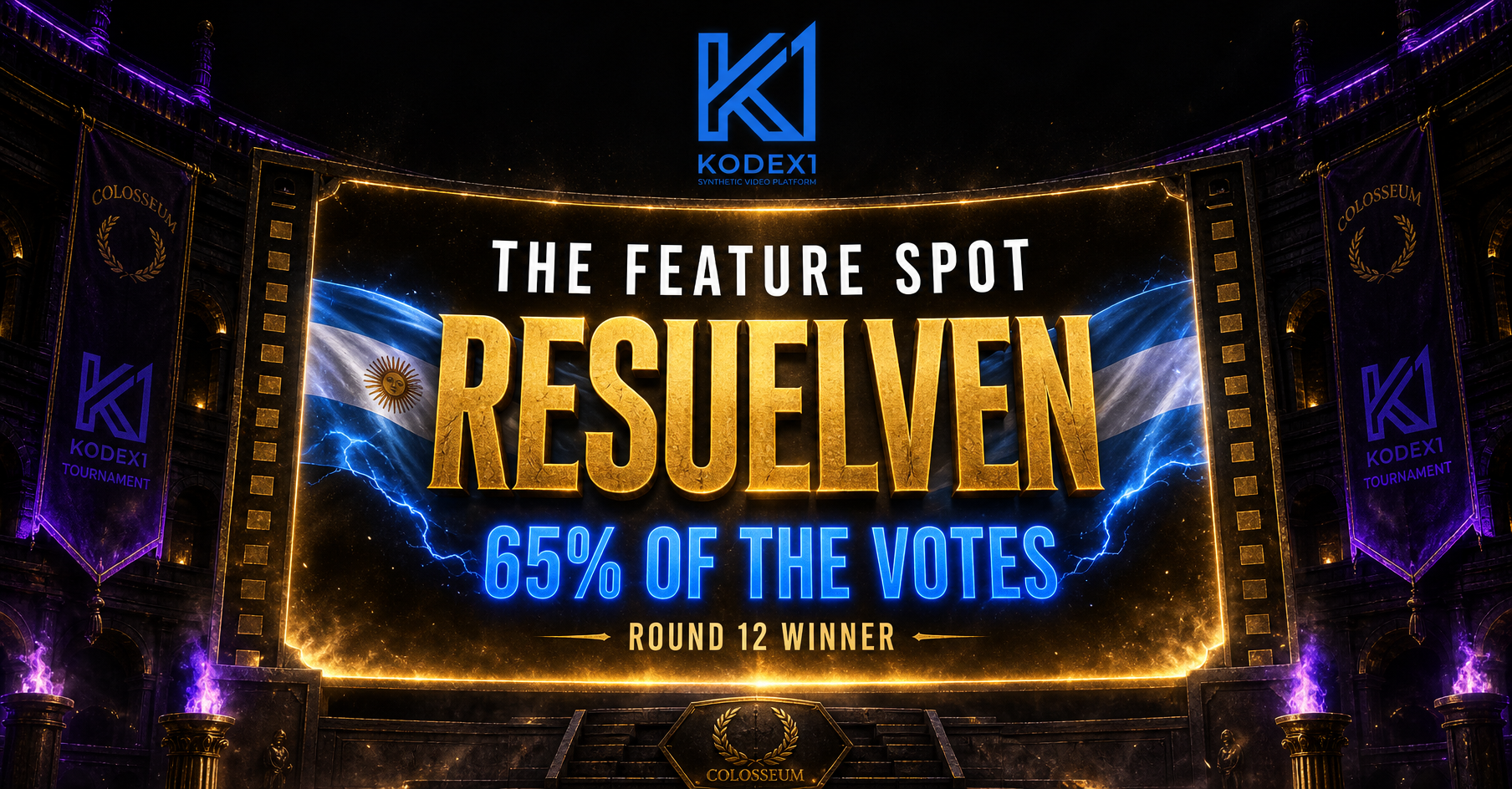
    Round 10 of the Kodex1 Coliseum is closed. The votes are in. And this week, Argentina didn't just show up — it dominated.

    resuelven took 65% of the vote in one of the most decisive Coliseum victories we've seen. The battle prompt was brutal in its simplicity: make a video for The Feature Spot — and it must include the Kodex1 logo. No machines this week. No AI challengers. Pure human vs. human. The arena was all directors, all craft, all on the line.

    resuelven answered the prompt and left the competition behind.

    What Was The Challenge?

    The Feature Spot is the most visible real estate on Kodex1 — the hero screen that greets every visitor who lands on the platform. This round asked directors to make something worthy of that spotlight. The twist: the Kodex1 logo had to be woven into the film itself. Not slapped on. Woven in.

    That's a creative constraint that separates the directors who understand cinematic storytelling from the ones who are just prompting.

    65%. No Machines. No Excuses.

    When the votes closed, resuelven had taken nearly two-thirds of them. In a humans-only battle where every competitor was fighting for the same prize, that margin is a statement.

    This wasn't a close call. It was a masterclass.

    What resuelven Wins

    The cash prize. Full stop.

    But more than that — resuelven's winning video now lives on The Feature Spot for the entire month. Every person who visits Kodex1 sees it first. Every new director who finds the platform lands on it. The work earns its audience the hard way: by being good enough to sit at the top of the most competitive AI filmmaking arena on the internet.

    That's not an algorithm. That's a vote.

    The Coliseum Keeps Moving

    Round 10 is closed. Round 11 is coming.

    If you're an AI director who missed this one — don't sleep on the next prompt. The Coliseum runs on speed, craft, and nerve. The directors who win aren't waiting to feel ready.

    They're already in the arena.

    Watch the winning video. Enter the next round. Build your legacy.

    👉 kodex1.com

  • Kodex1: The Home of AI Videos

    Kodex1: The Home of AI Videos

    Description

    Kodex1 is the home of AI videos — where directors using Kling, Seedance, Veo, Runway, Higgsfield, and OpenArt upload, compete, and build their legacy. Here's what's happening on the platform right now.

    Kodex1: The Home of AI Videos

    AI filmmaking just found its home. And it's busier than ever.

    When we built Kodex1, the idea was simple: give AI directors a permanent place to put their work — somewhere that wouldn't bury it in an algorithm, flag it, or let it disappear after 24 hours. A real platform. Built specifically for this new wave of creators who are using Kling, Seedance, Veo, Runway, Higgsfield, OpenArt, and whatever comes next to make things that genuinely stop people mid-scroll.

    A few months in, the community is building. Directors from across the world are signing up, uploading their work, competing in the Coliseum, and now — racking up points in the new league system. Here's what's actually happening.


    The Tools Showing Up Most on Kodex1

    We don't build the AI models. We build the home for the people who master them. Right now, these are the tools our directors are bringing to the arena.

    Kling

    Kling is everywhere on Kodex1. Kuaishou's video model — now at version 3.0 with 60 million users globally — has become the go-to for directors who want cinematic quality without fighting the tool. The physics hold up. The motion is smooth. The outputs feel directed, not just generated. Kling clips consistently show up in Coliseum entries and Director Studios across the platform. Kling AI

    Seedance

    ByteDance's Seedance 2.0 is making serious noise. Its unified multimodal architecture lets creators feed in images, video, audio, and text simultaneously — the result is a level of creative control most models don't offer. Seedance directors on Kodex1 tend to produce work that's layered and precise. It shows. Seedance 2.0

    Veo

    Google DeepMind's Veo 3.1 brings something different: 4K output, native audio generation, and physics-based realism that's hard to match. For directors building cinematic sequences with real-world environments and lighting, Veo is the weapon of choice. It's also the model that won the very first Kodex1 Coliseum round. Veo 3.1

    Runway

    Runway is the OG of the AI video world and it still delivers. Gen-4 offers frame-accurate camera controls, consistent characters across scenes, and the kind of editorial precision that serious directors need. Creators on Kodex1 who've been in this space the longest tend to have Runway in their toolkit. It's not the flashiest option right now — it's the one that works when the shot has to be right. Runway

    Higgsfield

    Higgsfield is built for creators who want everything in one place. Every top model — Kling, Veo, Seedance — accessible from a single workspace, with viral presets, character consistency tools, and direct plugins for Adobe Premiere Pro and After Effects. Directors who move fast and ship often are using Higgsfield to skip the tab-switching and stay in flow. Higgsfield

    OpenArt

    OpenArt has quietly become one of the most complete AI creative studios available. From image-to-video and Smart Shot storyboarding to lip-sync, video inpainting, and full character creation — it's a deep toolkit trusted by millions of creators worldwide. Directors on Kodex1 using OpenArt tend to bring a distinctive visual consistency to their work, because the platform gives them the kind of fine-grained control that makes a difference frame by frame. OpenArt


    12 Coliseum Rounds. 132+ Videos. The Arena is Real.

    The Coliseum has been running weekly since April and shows no signs of slowing down. The format is simple: a theme drops, directors upload their best interpretation, the community votes, and $100 goes to the winner. No judges. No panels. Just the work.

    Twelve rounds in, the competition is fierce. lucena.ia holds the record — three consecutive wins — and has earned every one of them. The Candy Zoo round, the Supernatural Pirate Battle, the Monsters of the Enchanted World — each one raised the bar.

    Round 12 is live now at kodex1.com/coliseum. Human directors only. No bots. $100 cash + a featured spot on the front page for a month. Two weeks to enter.


    The New League System — Points, Rankings, and Something to Chase

    The Coliseum is weekly. The league is the long game.

    We built the Kodex1 League system because the best creators deserve more than one shot at recognition per week. The league runs monthly. Directors accumulate points across every video they upload, every vote they receive, every Coliseum battle they enter. At the end of the month, the leaderboard settles and the top directors take the prize.

    It adds a layer of strategy the Coliseum alone doesn't have. Do you go all-in on one cinematic piece, or build a consistent body of work across categories? Do you chase votes or chase volume? The directors who figure out that answer first are the ones climbing fastest.

    The league is live. Points are counting. Check your studio page to see where you stand.


    Why Kodex1 Exists

    YouTube is making life difficult for AI content creators. Demonetisation, content flags, algorithm suppression — the platforms built before AI video existed don't know what to do with it. So they do what platforms always do when something new disrupts their model: they make it harder.

    Kodex1 doesn't have that problem. We built this specifically for AI-generated video. There's no algorithm that doesn't understand what a Kling cinematic is. No flag system that mistakes a Veo sequence for a policy violation. No feed that buries your best work under yesterday's trending audio.

    This is the permanent home for AI filmmaking. A Director Studio that doesn't go anywhere. A competitive arena that rewards skill. A community that knows exactly what it's watching.


    Join the Arena

    If you're already making AI videos — with Kling, Seedance, Veo, Runway, Higgsfield, OpenArt, or anything else — Kodex1 is where that work belongs.

    Upload three videos, unlock your Director Studio, and start competing. The league is live. The Coliseum is running. The community is watching.

    Start here → kodex1.com