Tag: kodex1

  • How to Win an AI Film Competition: The Complete Director’s Playbook

    How to Win an AI Film Competition: The Complete Director’s Playbook

    Most submissions to an AI film competition fail in the first ten seconds. The opening shot reveals a melting hand, a character whose face shifts between cuts, or a generic slow-motion drone glide over an imaginary cyberpunk city. The audio is an unmixed stock track that drowns out flat synthetic narration.

    Judges screen hundreds of submissions over a single weekend. They do not grade on the raw novelty of prompting a diffusion model. By 2026, anyone can type an ambitious prompt into Kling, Runway, or Sora and spit out five seconds of 4K spectacle. Visual ambition without story structure is white noise.

    To win an AI film competition, you have to direct the machine instead of letting the machine direct you. Winning films demonstrate narrative coherence, strict continuity, intentional camera grammar, and professional sound design. Here is the exact playbook to move your project from the submission pile to the awards podium.

    What do judges actually look for in an AI film competition?

    Judges evaluate four core pillars when scoring entries:

    1. Story and emotional resonance (40%): Does the short have a clear dramatic arc? Is there a protagonist with a concrete goal and real stakes? A ninety-second short that makes the audience feel tension or grief beats a three-minute tech demo every time.
    2. Character and visual continuity (25%): Can you hold the same character across three distinct angles and lighting setups? If your lead actor swaps bone structure between shots, you lose points immediately.
    3. Cinematic intent and camera grammar (20%): Did you pick camera moves that serve the emotion of the scene, or did you accept whatever random panning motion the generative model gave you? Every pan, push, and Dutch angle must feel deliberate.
    4. Sound design and audio mixing (15%): Bad audio ruins good video. Festivals demand dedicated Foley, ambient room tone, balanced dialogue, and custom scoring that hits cut points cleanly.

    If you want to test how your work holds up under pressure before submitting to a major festival, enter the Kodex1 Coliseum. Coliseum rounds pit creators against timed prompts and live community voting, giving you immediate feedback on what grips an audience.

    How long should an AI competition film be?

    Keep your film between 60 and 120 seconds. Unless a festival brief specifically demands a longer piece, tighter is always better.

    Festival jurors spend long hours reviewing submissions. A tight, punchy 90-second film maintains pacing and hides the micro-artifacts inherent to generative models. When you stretch an AI short past three minutes without a massive budget and full VFX cleanup, generative fatigue sets in. The audience starts noticing rubbery limbs, drifting eye lines, and unnatural background motion. Pack your story into two minutes max.

    Can you use multiple AI tools in one film?

    Yes. Winning directors never rely on a single generative model. They build a multi-tool pipeline that plays to each platform’s strengths:

    • Character generation and base keyframes: Midjourney v6, Flux.1, or Stable Diffusion for consistent character turnarounds and lighting reference sheets.
    • Action and complex physics: Kling 1.5/2.0 for heavy physical interaction, fabric dynamics, and reliable facial retention during movement.
    • Camera control and stylized VFX: Runway Gen-3 Alpha for precise camera motion brushes, directional pans, and controlled pacing.
    • Environment and cinematic scale: Google Veo or Luma Dream Machine for architectural wide shots and atmospheric establishers.
    • Post-production conform: DaVinci Resolve or Adobe Premiere for edit assembly, color grading, speed ramps, and frame interpolation.
    • Audio and voice synthesis: ElevenLabs for voice acting, paired with sound design tools and manual DAW mixing.

    Judges respect a clear production breakdown. Disclose your stack openly in your project notes. Demonstrating that you directed four different engines into one cohesive visual style proves you are a director, not a prompt passenger.

    The 6-step workflow to win an AI film competition

    1. Write for generative constraints

    Do not write an action scene requiring ten characters wrestling in a crowded market unless you want to spend three weeks rotoscoping. Write scripts that leverage what generative models do well:

    • Solo protagonists or two-hander dialogues.
    • Atmospheric, high-concept environments (sci-fi ruins, isolated research outposts, surreal historical settings).
    • Visual metaphors where slight physical uncanny valley adds psychological weight rather than breaking immersion.

    2. Lock your character bible before generating video

    Create a master character sheet with 6 to 10 distinct angles, neutral expressions, and consistent lighting in your still image generator. Use these reference images as seed frames for image-to-video generation.

    When running generations in Kling or Runway, keep the character’s core wardrobe constant. High-contrast jackets, distinctive hats, or specific glasses help anchor viewer recognition even when the engine shifts subtle facial geometry.

    3. Direct the cut, not just the prompt

    Amateur entries string together ten unrelated beauty shots. A professional short relies on classic cinematic coverage:

    • Establishing shot: Sets geography and mood.
    • Medium shot: Introduces the character action.
    • Over-the-shoulder / Close-up: Establishes emotional stakes and eye contact.
    • Cutaway / Detail shot: Hides transitions and builds tension.

    If a generated clip glitches on second four, cut on second three. Use hard cuts on motion rather than cross-dissolves. Cross-fading between two AI clips screams amateur reel.

    4. Build a tactile soundscape

    Generative video has no weight until sound hits it. Mute all native audio outputs from video generators.

    Layer your sound in a proper timeline:
    1. Sub-bass and room tone: Low rumbles, air conditioner hums, wind pressure.
    2. Foley: Footsteps, cloth rustling, leather creaks, breathing.
    3. Diegetic sound: Mechanical clicks, rain hitting glass, engines idling.
    4. Score: Subtle melodies that avoid drowning out narrative dialogue.

    5. Color grade to unify multiple models

    If shot one came from Kling and shot two came from Runway, the color science and black levels will clash. Bring your complete sequence into DaVinci Resolve or Premiere. Apply a unified film emulation LUT, balance your shadows, and add a fine 35mm film grain overlay across the entire timeline. Grain acts as visual glue, binding disparate AI generations into one photographic world.

    6. Submit early and verify technical specs

    Never submit five minutes before the deadline. Export your master in ProRes 422 or pristine H.265/H.264 matching the competition’s exact aspect ratio (usually 16:9 or 2.39:1 anamorphic). Check your audio loudness levels: aim for -14 LUFS for web-streamed festivals and -24 LKFS for broadcast-spec screenings.

    Where to submit your AI film in 2026

    Once your short is polished, enter these key competitions:

    • Runway AI Film Festival (AIFF): High industry visibility, major cash prizes, and theatrical screenings in New York and Los Angeles.
    • Curious Refuge Competitions: Regular genre-specific challenges with substantial creative community engagement.
    • AI for Good Film Festival (Geneva / United Nations): Focuses on global challenges, ethics, and humanitarian storytelling.
    • Independent FilmFreeway AI categories: Traditional film festivals like Fantasia, Sitges, and regional festivals increasingly host dedicated generative short categories.

    Build a permanent home for your winning work

    Winning an award or landing a finalist spot gives you a temporary spike in visibility. But social media feeds bury your achievement within 48 hours. A Discord link or a tweet does not build a career.

    Professional creators need a permanent studio where scouts, producers, and brands can review their full catalog. Set up your channel on Kodex1 Directors. Kodex1 gives AI filmmakers dedicated studio portfolios with custom URLs, verified badges, and direct client commission tools.

    When you have a body of work ready for monetization, check Kodex1 Earn to see how directors sell licenses, monetize film tickets, and take on paid commercial briefs.

    Ready to test your skills?

    Stop waiting for the next annual festival deadline. Sharpen your storytelling instincts, master rapid turnaround briefs, and compete for cash right now. Head over to Kodex1 and take your place in the arena.


  • How to Monetize AI Video in 2026 (The Real Way)

    How to Monetize AI Video in 2026 (The Real Way)

    How to Monetize AI Video in 2026 (The Real Way)

    Meta description: Stop chasing AdSense. Here are five proven ways AI directors actually make money from their work in 2026. From competition prizes to paid commissions and download sales.


    Everyone entering the AI video space asks the same question eventually: can I actually make money from this?

    The short answer is yes. The longer answer is that the method matters enormously. Most advice online was written for a world where you could pump out AI-generated content, paste it on YouTube, and collect ad revenue. That world is closing fast. YouTube just updated its monetization policies in July 2026 to explicitly flag low-effort, repetitive AI-generated content as ineligible for ads. The "passive income from AI slop" pipeline is getting shut down.

    But that is not bad news if you are actually making something. Directors who treat AI video as a craft. Who direct, not just prompt. Have more revenue paths open right now than at any point in the medium's short history. Here is how they work.


    Can You Make Money from AI-Generated Videos?

    Yes. But the phrasing matters. You cannot make money by being a generator. You can make money by being a director.

    The distinction is not semantic. A generator runs a prompt and exports whatever comes out. A director makes deliberate choices. Shot composition, pacing, character consistency, narrative arc, sound design. The tools are the same. The output is completely different. And the market rewards the difference.

    AI directors in 2026 earn from five primary channels: competition prizes, download sales, custom commissions, brand work, and platform monetization on the handful of platforms built specifically for the format. Each has a different risk and effort profile.


    1. AI Film Competitions

    This is the fastest path to real cash for a new director. AI film competitions pay out prizes ranging from $50 for a single battle to $500+ for major events, with entry costs typically at zero. The ratio of effort to reward is hard to beat when you are already making work.

    The key is finding competitions with real judges or community voting. Not algorithmic popularity contests. Battle-format arenas, where individual films go head-to-head with visible vote counts, give you immediate feedback on what works cinematically versus what just looks technically impressive.

    The Kodex1 Coliseum runs recurring battle rounds with cash prizes and a community that actually knows the tools. Recent rounds have paid out $100, $200, and a standing prize structure for ongoing battles. If you are using Kling, Runway, or any serious generation tool, entering costs you nothing beyond the time to submit.


    2. Selling Video Downloads

    If you have made strong AI films, those files have direct commercial value. Brands, agencies, motion designers, and other creators buy AI video clips as b-roll, loop content for social ads, ambient background material, and visual assets for their own projects.

    The model works similarly to stock footage but with a crucial advantage: you are not competing against a library of a million clips. AI-generated cinematic material at a high quality level is still scarce. A well-lit, temporally consistent 10-second character clip in a specific style is worth real money to someone who needs exactly that.

    The challenge with selling downloads is distribution. You need a platform where buyers can find your work, preview it, and pay cleanly. Without you managing it manually. Director Studio on Kodex1 gives you exactly that setup: a public portfolio, an enabled download storefront, and the ability to set your own prices per tier. Upload three or more original pieces (20 seconds or longer), and the studio activates automatically.


    3. Custom Video Commissions

    This is the highest-earning path for experienced directors. A brand, production company, or individual client pays you to produce a specific AI video to their brief. You set rates. You own the client relationship. No platform takes a percentage of your creative judgment.

    Commission rates in 2026 vary widely depending on complexity, tool costs, and turnaround. Short clips (under 20 seconds) for social ad use typically range from $150 to $500. Longer narrative pieces or multi-clip sequences run higher. The bottleneck is not demand. Brands want this content and budgets for AI-produced video are rising. The bottleneck is discoverability. Clients cannot hire you if they cannot find you.

    A visible portfolio with a working hire mechanism removes that bottleneck. Directors on Kodex1 with active studios can be reached directly through a Hire button on their profile. Clients choose from three video length tiers, pay into escrow, and a project room opens for delivery. You set the rates per tier. Three revisions are included in the standard flow.

    This is not a hypothetical feature. It is live. If you have the work and you are not using infrastructure like this, you are leaving money on the table.


    4. Brand Work and Sponsored Content

    Once you have an audience or a visible body of work, brands come to you directly. AI tools companies, gaming platforms, entertainment projects, and tech startups all want directors who understand the format. They pay for showcase reels, product demos, event content, and social ads built with AI video.

    The best way to attract this work is counterintuitive: stop trying to attract it directly. Build a consistent body of strong cinematic work. Win a competition or two. Get visible in the communities where your potential clients spend time. Brand work follows reputation. It does not follow follower counts.


    5. Platform Monetization (Built for AI Video)

    YouTube's updated 2026 policies make one thing clear: platforms built for general audiences are not going to carry AI directors the way early adopters hoped. Ad-split revenue requires volume, audience retention metrics, and content that passes increasingly strict "reused content" filters. AI video made with serious intent can qualify. But the path is slow and uncertain.

    Platforms built specifically for AI video operate differently. They are not trying to optimize for watch time across 500 million pieces of content. They are curating for quality and directing audience attention toward specific creators. The monetization mechanics are built around the work itself. Downloads, commissions, competition prizes. Rather than layered on top of an ad network that barely tolerates your content category.

    This is the architecture Kodex1 is building. The Coliseum drives competitive pressure and community engagement. Director Studios give you the permanent portfolio and commerce infrastructure. The Earn section ties it together. You make the work. The platform routes the opportunity.


    Does YouTube Monetize AI Videos in 2026?

    Yes, but with significant caveats. YouTube's July 2026 policy update explicitly targets "mass-produced, repetitive, or low-effort AI-generated content" and classifies it as ineligible for AdSense monetization. Content that relies heavily on AI generation without added original commentary, narrative structure, or editorial effort now faces demonetization.

    AI films with genuine directorial input. Original story, deliberate pacing, unique visual language. Still qualify. But the review process is opaque and appeals are slow. Directors who depend solely on YouTube ad revenue for AI work are building on unstable ground.

    The practical takeaway: YouTube can be a distribution channel. It should not be your monetization strategy.


    How Do AI Directors Get Paid for Commissions?

    The cleanest commission setups use escrow: the client pays upfront, funds are held until delivery is confirmed, then released to the director. This protects both sides. Avoid arrangements where payment comes after delivery with no escrow. Chasing invoices from clients who ghost after receiving the work is a common and entirely avoidable problem.

    For ongoing clients, retainer agreements work well. A brand might pay $500/month for two 15-second social clips per week. That is 8 clips per month at a predictable cadence. Workable with modern generation tools if you have a fast prompting and editing workflow.


    The Real Monetization Stack for AI Directors in 2026

    If you want a practical answer to "how do I make money from AI video", here is a working stack:

    Foundation: A public portfolio with your strongest 5-10 pieces. Not a Google Drive folder. A real, browsable page where anyone can see your aesthetic and range.

    Entry revenue: Enter every relevant competition you find. The prize money is secondary to the reps. You get feedback, visibility, and a track record of competitive finishes.

    Active revenue: Turn on download sales and commissions through a Director Studio. Set your rates. Let the work sell itself.

    Inbound: Keep making and publishing. Every strong piece adds to your discoverability. Every competition finish adds to your credibility.

    Scale: As your commission volume grows, raise rates. Route lower-tier requests to download sales. Protect your time for the work that pays proportionally.

    The directors making consistent money from AI video in 2026 are treating it like a craft business, not a side hustle. The tools are powerful enough that quality is achievable. The infrastructure to monetize it now exists. What it takes is the decision to take it seriously.


    Ready to set up your Director Studio and start competing in the Coliseum? Head to kodex1.com. The permanent home for AI directors who are building something real.

  • The Best AI Short Film Competitions in 2026 (And How to Actually Win)

    The Best AI Short Film Competitions in 2026 (And How to Actually Win)

    Description

    The best AI short film competitions in 2026 ranked and explained — from Runway's AI Festival to the Kodex1 Coliseum. Enter smarter, compete harder, and actually win.

    The Best AI Short Film Competitions in 2026 (And How to Actually Win)

    The AI short film competition scene has gone from novelty to serious battlefield in less than two years. Prize pools are up. Judging standards are higher. And the directors who win aren't the ones with the best prompts — they're the ones with a strategy.

    This is every major AI short film competition running in 2026, what each one demands, and how you position yourself to walk out with the prize.


    What Is an AI Short Film Competition?

    An AI short film competition is exactly what it sounds like: a film contest where entrants use AI video generation tools — Kling, Runway, Sora, Veo, Luma, or any combination — to create original short films. Judges score entries on storytelling, visual quality, creative direction, and often on how effectively the director has controlled the AI rather than just letting it run wild.

    The distinction matters. The best competitions aren't looking for the most technically impressive generation. They're looking for a director who used the machine to tell a story worth watching.


    The Major AI Short Film Competitions in 2026

    1. Runway AI Festival (AIF 2026)

    Runway's fourth annual AI Festival is the closest thing the generative cinema world has to a flagship event. Originally launched in 2022 as a pure AI film showcase, AIF has expanded into an interdisciplinary program that covers film, music, and interactive work. For directors, it remains the highest-profile competition in the space — a win here lands on your director page with real credibility behind it.

    The competition draws global submissions and Runway curates entries with a clear eye toward craft, not just technical output. Read more at aif.runwayml.com.

    2. World AI Film Festival (WAIFF)

    WAIFF runs international editions that select the five best AI-driven films from each country. Those national finalists then travel to Cannes for the Grand Finale at the Palais des Festivals. That's not a small detail. This is the Cannes Palais — for AI filmmakers.

    If you're building a director career and want a single credential that opens doors with traditional film industry contacts, WAIFF is the one to target. The judging standards reflect that ambition. Details at worldaifilmfestival.com.

    3. Forward Festival x LTX: AI Shortest Film Competition

    Forward and LTX are running an open call built around a specific philosophy: AI is a medium, not a shortcut. The format rewards creative constraint — the "shortest film" premise forces directors to make every second count. No padding. No hiding behind runtime.

    If you're a director who thinks in sequences and not just single generations, this format plays to that strength. More at forward-festival.com.

    4. Reply AI Film Festival

    Reply AIFF is one of the more established dedicated AI film competitions, running annually with a submission window that typically closes in late spring. Entries use AI to generate or enhance footage, with judges scoring on narrative ambition and execution. The 2026 edition extended its deadline to reflect the growing submission volume — a sign of how much the field has grown.

    5. Google x XPRIZE: Future Vision Film Competition

    Google partnered with XPRIZE and Range Media Partners on the Future Vision film competition with $3.5 million in prizes — the largest prize pool in AI filmmaking history. The competition invites AI-assisted films that explore humanity's future, scored on storytelling, visual innovation, and thematic ambition. This is not a beginner's entry: the competition runs at a level that demands a real directorial voice. Announced on the Google Blog.

    6. Kodex1 Coliseum

    The Coliseum operates differently from every other competition on this list. There's no annual submission window. No months-long wait for results. Battles run live on the platform for 48 hours, the community votes in real time, and winners get paid.

    The current World Cup battle has $200 on the line, runs through July 19, and is open now. Enter at kodex1.com/coliseum. If you want to compete regularly — not once a year — the Coliseum is the only arena built for that cadence. Every entry adds to your director record. Every win is permanent on your profile.


    What Do AI Film Competition Judges Actually Look For?

    The answer shifted in 2025 and has held through 2026. Early AI film competitions rewarded technical novelty — the wildest generation, the most seamless motion, the clip that made people say "I can't believe AI did that." That era is over.

    Judges across every major competition now score on:

    Directorial control. Did a human make intentional decisions about every frame, or did the director just run a prompt and post the first result? Judges can tell the difference. Generated footage with no edit structure, no consistent visual logic, and no sense of pacing signals low directorial input. That entry loses.

    Narrative coherence. A 90-second film needs a beginning, a middle, and an end. Not necessarily a traditional story arc — but something that earns the audience's attention and then resolves it. Clip dumps disguised as films don't survive the first round of judging.

    Visual consistency. Character, location, and lighting consistency across a multi-shot piece is still technically hard with AI tools. Directors who solve that problem — through reference images, consistent prompting, or manual compositing — instantly separate themselves from the field.

    Sound. The number of competition entries that arrive with no sound design, or with royalty-free music slapped on as an afterthought, is still staggering. A serious sound pass is one of the fastest ways to move from the bottom third to the top third of any submission pool.


    How Do You Enter an AI Film Festival?

    Every competition runs its own submission process, but the mechanics are similar across all of them:

    1. Read the rules before you generate a single frame. Length requirements, allowed tools, disclosure obligations, and rights terms vary. Some competitions require you to disclose every AI tool used. A few restrict specific commercial platforms. Know this before you invest production time.

    2. Prepare a proper submission package. Most competitions want a title, a director statement, a synopsis, and technical credits alongside the film itself. A weak director statement on a strong film still costs you points. Write it like you mean it.

    3. Check the file specs. Resolution, codec, file size — delivery failures on technical grounds happen more than anyone admits. Export clean, export early, and check the file before the deadline.

    4. Submit before the deadline closes. Not at midnight. Submission portals get overloaded at the last hour and entry failures right before close are unrecoverable.


    Are AI-Generated Films Allowed at Traditional Film Festivals?

    This is the question every AI director searches eventually, and the answer in 2026 is: it depends on the festival, and the rules are still in flux.

    Sundance has hosted AI-related panel discussions (including one with Andrew Ng in early 2026) but hasn't formally defined an AI film category. Most traditional festivals still require human authorship disclosures when AI tools were involved and some jury members actively downgrade AI-assisted entries in open categories.

    The practical answer: submit to AI-native competitions first. Build your competition record there. A win at WAIFF or Runway AIF is a real credential — one that opens conversations with traditional festival programmers who are already watching the AI film space closely.


    How to Win an AI Short Film Competition

    Winning isn't about having the best AI tool. It's about being the best director in the field.

    Pick a prompt that has a point. Competitions with open briefs expose every director equally. The entries that lose have no reason to exist — they're technically fine but say nothing. Before you generate the first frame, answer one question: what does this film make the audience feel? If you can't answer it, find a different angle.

    Direct every shot. Don't run a prompt and accept the first result. Generate in volume — three to five variations per shot — and cut ruthlessly. The directors who win Coliseum battles on Kodex1 and take home prizes at AIF are the ones generating fifty clips and keeping ten. Volume generation paired with editorial discipline is the move.

    Build a body of work before the competition opens. The directors who win major competitions aren't running their first film in the competition. They've already made five. The ones who've built a director portfolio on Kodex1 have something traditional competition entrants don't: a public record of their directorial decisions, their visual language, and their development over time. Judges at serious competitions research directors. Give them something to find.

    Enter the fast-cycle competitions to sharpen your craft. Annual competitions give you one shot per year. The Coliseum gives you a shot every two weeks. There's no substitute for live reps — enter, get voted on by a real community, win or lose, and carry the feedback into the next piece.

    Nail the sound. Worth repeating. Score it properly. Add foley. Mix the levels. It is the single fastest upgrade available to any AI film and most directors skip it entirely.


    The Arena Is Open

    The AI short film competition scene in 2026 is the most competitive it has ever been — and the most rewarding. Prize pools are real. Credibility is building. And the directors putting in the reps right now are the ones who'll own the record when the field gets crowded.

    If you're serious about competing, start with the Coliseum. Build your record, earn your director page, and go into annual competitions with a body of work behind you.

    Enter the Coliseum at kodex1.com/coliseum. The World Cup battle has $200 on the line and closes July 19. The arena is live now.

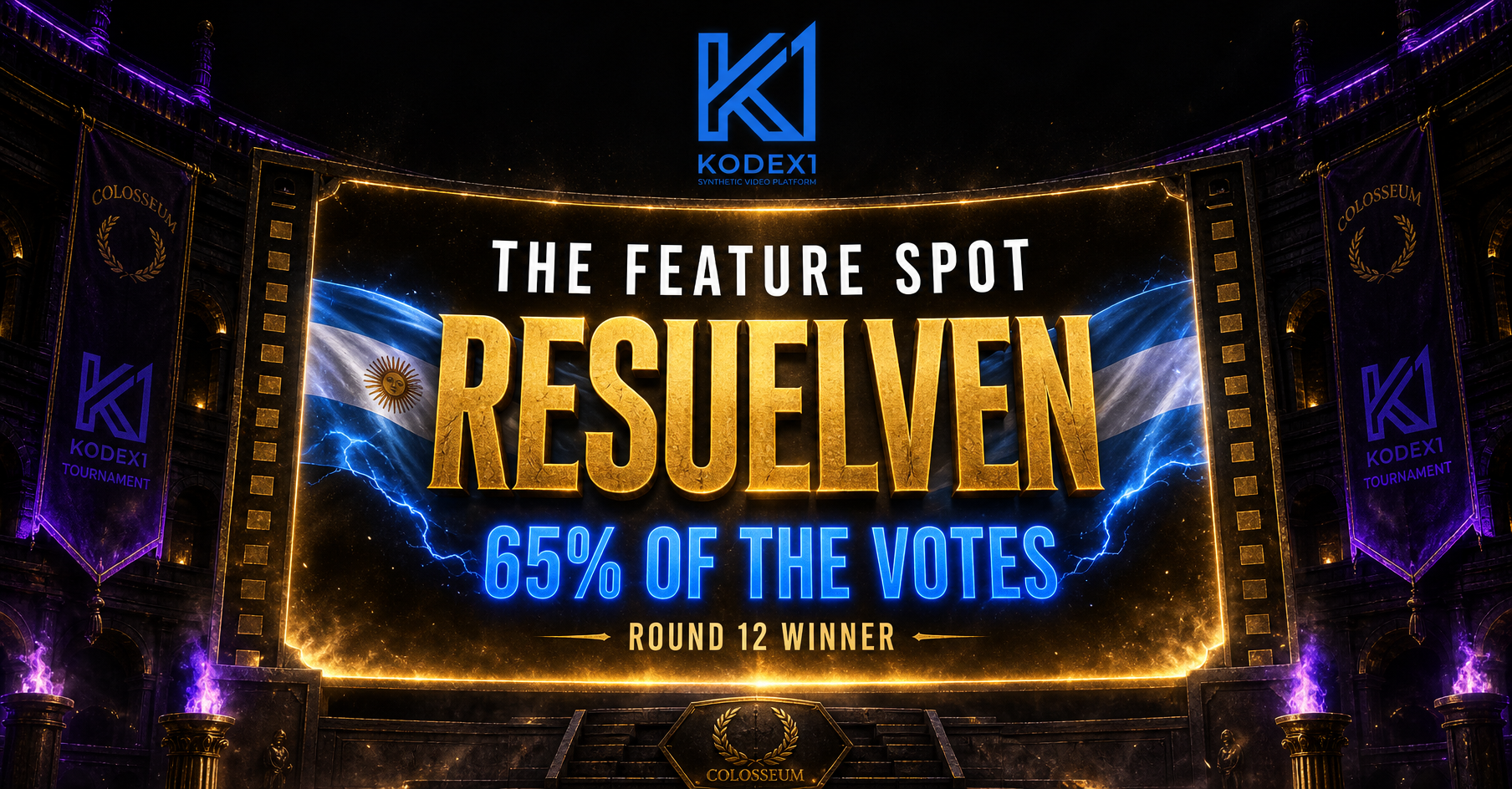
  • Argentina Takes The Coliseum: resuelven Wins The Feature Spot

    Argentina Takes The Coliseum: resuelven Wins The Feature Spot

    Round 10 of the Kodex1 Coliseum is closed. The votes are in. And this week, Argentina didn't just show up — it dominated.

    resuelven took 65% of the vote in one of the most decisive Coliseum victories we've seen. The battle prompt was brutal in its simplicity: make a video for The Feature Spot — and it must include the Kodex1 logo. No machines this week. No AI challengers. Pure human vs. human. The arena was all directors, all craft, all on the line.

    resuelven answered the prompt and left the competition behind.

    What Was The Challenge?

    The Feature Spot is the most visible real estate on Kodex1 — the hero screen that greets every visitor who lands on the platform. This round asked directors to make something worthy of that spotlight. The twist: the Kodex1 logo had to be woven into the film itself. Not slapped on. Woven in.

    That's a creative constraint that separates the directors who understand cinematic storytelling from the ones who are just prompting.

    65%. No Machines. No Excuses.

    When the votes closed, resuelven had taken nearly two-thirds of them. In a humans-only battle where every competitor was fighting for the same prize, that margin is a statement.

    This wasn't a close call. It was a masterclass.

    What resuelven Wins

    The cash prize. Full stop.

    But more than that — resuelven's winning video now lives on The Feature Spot for the entire month. Every person who visits Kodex1 sees it first. Every new director who finds the platform lands on it. The work earns its audience the hard way: by being good enough to sit at the top of the most competitive AI filmmaking arena on the internet.

    That's not an algorithm. That's a vote.

    The Coliseum Keeps Moving

    Round 10 is closed. Round 11 is coming.

    If you're an AI director who missed this one — don't sleep on the next prompt. The Coliseum runs on speed, craft, and nerve. The directors who win aren't waiting to feel ready.

    They're already in the arena.

    Watch the winning video. Enter the next round. Build your legacy.

    👉 kodex1.com