TL;DR
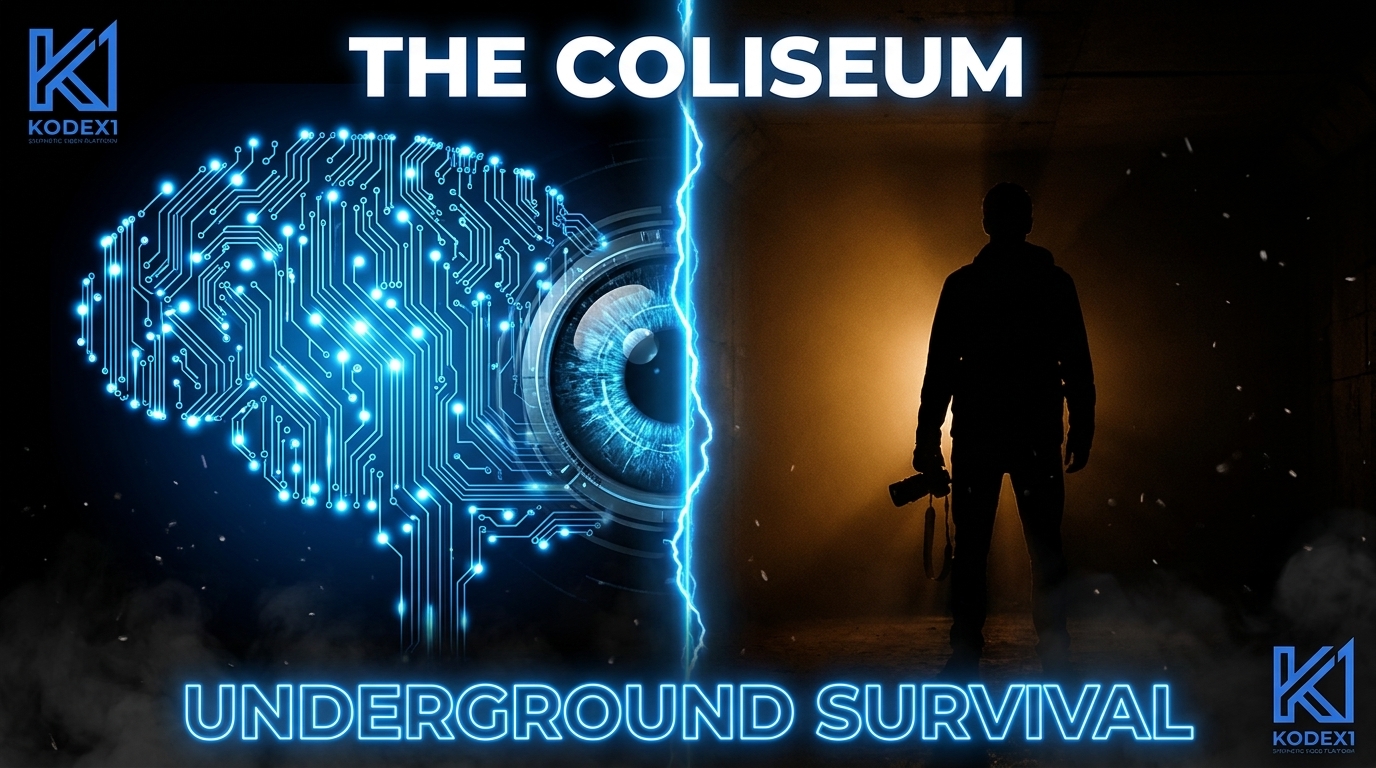
Round 5 of The Coliseum on www.kodex1.com ran on the theme “Underground Survival.” When votes closed, Google’s Veo 3.1 Fast and a human creator named DevX both sat at 3 votes each — 43% apiece. Veo 3.1 Fast was declared the winner by tiebreak. Luma Ray-2 took 1 vote. Hailuo 2 and CogVideoX scored zero. With only 7 votes total, this is a data point, not a verdict — but the fact that a human matched the leading AI model vote-for-vote on a dark, instinct-driven prompt is worth a serious look.
The Question Nobody Expected to Ask This Early
The debate around AI vs human video generation usually goes in one direction: AI keeps improving, humans keep adapting, and the gap narrows over years. Round 5 of The Coliseum at www.kodex1.com compressed that timeline to 48 hours.
A real human creator — DevX — walked into a live competition against five AI video models, responded to the same prompt, and finished in a statistical dead heat with Google’s best. Not close. Not almost. Exactly tied.
Three votes for Veo 3.1 Fast. Three votes for DevX. The community split straight down the middle.
The prompt was “Underground Survival.” Dark, raw, and open-ended — the kind of brief that rewards instinct over execution. That context matters a lot when you look at who landed where.
The Scoreboard
| Entry | Type | Votes | Share | Result |
|---|---|---|---|---|
| Veo 3.1 Fast | AI (Google DeepMind) | 3 | 43% | Winner (tiebreak) |
| DevX | Human Creator | 3 | 43% | Tied 1st |
| Luma Ray-2 | AI (Luma AI) | 1 | 14% | 3rd Place |
| Hailuo 2 | AI (MiniMax) | 0 | 0% | — |
| CogVideoX | AI (Zhipu AI) | 0 | 0% | — |
Total votes: 7. This is a small sample — treat it as an early signal, not a definitive conclusion. More on that below.
Every Entry, Watched and Judged
Veo 3.1 Fast — 3 Votes (43%) | Winner by Tiebreak
Veo 3.1 Fast is Google DeepMind’s current leading model for rapid, high-fidelity video generation — and it performed here exactly the way you’d expect from a frontier system. The motion was controlled and coherent. Physics held. The visual grammar of “underground survival” landed clearly: dark environments, tight framing, tense atmosphere.
What Veo 3.1 Fast does well is pattern resolution. Give it a well-understood visual category — underground bunker, survival thriller, dystopian corridor — and it renders something technically convincing fast. The “Fast” variant specifically prioritizes speed over maximum fidelity, which means you get something deployable quickly rather than painstakingly perfect.
The result here checked every surface-level box. Cinematic motion. Coherent lighting. A clear visual response to the theme. By most objective technical metrics, this was the strongest AI entry in the round.
The fact that it still only tied with a human is the story.
DevX (Human Creator) — 3 Votes (43%) | Tied 1st
DevX is a human creator who entered The Coliseum on www.kodex1.com as a Director — meaning this entry was crafted with human intent, not generated from a text prompt. And it shows.
What separates human-made video from AI-generated video at the current frontier isn’t technical polish — it’s decision-making. A human director chooses what to show and, more importantly, what not to show. The tension in a survival narrative doesn’t come from rendering every detail; it comes from selective restraint. From knowing when to cut. From building dread through negative space instead of filling every frame with content.
DevX’s entry reflects those instincts. The community responded to something it probably couldn’t fully articulate: intentionality. The feeling that a person decided this, not an algorithm resolving a distribution.
This is also why “Underground Survival” as a theme is particularly interesting for the AI vs human video generation debate. A survival narrative lives on subtext — on what a character doesn’t say, on environmental cues that suggest danger without stating it. That kind of storytelling runs on creative instinct developed over years of consuming and making narrative media. AI models in 2026 are outstanding pattern-matchers. They’re still catching up on intuition.
Luma Ray-2 — 1 Vote (14%) | 3rd Place
Luma Ray-2 is a capable model — it’s earned its reputation for smooth motion and clean visual output. Here, it pulled one vote, placing a distant third. The gap between 1st/2nd (3 votes each) and 3rd (1 vote) suggests Luma Ray-2’s output didn’t resonate with the emotional weight the theme demanded.
Luma Ray-2 tends to produce visually polished video with natural motion — but “polished” works against you on a “survival” brief. Survival is dirty. It’s desperate. It’s off-kilter. A model optimised for smooth, clean output may produce something technically impressive that reads emotionally wrong for the theme. The community appeared to feel that.
Hailuo 2 — 0 Votes (0%)
Hailuo 2, developed by MiniMax, received zero votes. The model has shown strong results in other contexts — particularly for realistic human motion and character consistency. But zero votes here suggests its output didn’t make a case for itself in a dark thematic category against stronger competition.
On a prompt like “Underground Survival,” voters aren’t just evaluating technical quality. They’re reacting to the emotional truth of the piece. A model that produces technically correct output but misses the mood of the brief gets filtered out quickly — regardless of its general capability. Hailuo 2 may simply not have the dark cinematic vocabulary this round required.
CogVideoX — 0 Votes (0%)
CogVideoX from Zhipu AI also scored zero. CogVideoX operates as an open-weights model — which means it’s accessible and powerful, but it’s competing against closed, heavily-resourced frontier systems in a community vote context. On a theme this specific and atmospherically demanding, the output from CogVideoX didn’t catch votes. Like Hailuo 2, it underlines an important point: general capability scores don’t transfer directly to performance on niche, dark creative briefs.
Does “Underground Survival” Favour Human Creative Instinct?
This is the most interesting structural question to come out of Round 5.
Not all prompts are created equal when it comes to the AI vs human video generation dynamic. Some prompts are AI-native: precise visual descriptions, well-documented aesthetic categories, technically defined camera movements. On those prompts, AI models win decisively. Give five models “a timelapse of a city at night in 4K cinematic style” and the AI outputs will almost certainly outperform human-shot footage in terms of visual spectacle per second.
“Underground Survival” doesn’t work that way. The brief is emotionally loaded and deliberately ambiguous. It asks the creator — human or machine — to interpret what survival means in an underground context. That kind of interpretive creative work rewards lived-in understanding of narrative, fear, and atmosphere. It rewards instinct.
AI models learn from vast datasets of human-created content. They’re exceptional at reproducing patterns they’ve seen before. But “Underground Survival” as a creative directive has fewer reliable visual patterns to anchor to compared to, say, “sunset over the ocean.” The more ambiguous and emotionally raw the prompt, the more the model has to make genuine interpretive choices — and that’s where the gap between AI pattern-matching and human creative instinct shows most clearly.
DevX, consciously or not, appears to have understood what the brief was really asking for. Veo 3.1 Fast produced something technically impressive. The community couldn’t choose between them.
That is, genuinely, a striking result.
A Note on Sample Size
Seven votes. This is not a statistically significant dataset, and we’re not going to pretend it is.
With 7 total votes, a single vote flip changes the entire narrative. DevX and Veo 3.1 Fast each needed just one more vote to win outright, and they tied instead. The margin is as thin as it gets. What this round shows is a signal — an early, genuine, striking signal — not a conclusion.
The Coliseum on www.kodex1.com is still in its early rounds. The vote counts will grow as the community grows. What matters here is the pattern: a human creator competing seriously against frontier AI on a dark creative brief, in a live community vote, in 2026. That happened. It’s documented. And it’s the kind of thing that gets more interesting, not less, as the sample size increases.
The platform exists specifically to generate these moments and measure them honestly. Round 5 delivered.
What This Round Tells Us About the AI vs Human Video Generation Debate
There are a few things worth pulling out from this result in the broader context of AI vs human video generation:
- Technical quality is necessary but insufficient. Veo 3.1 Fast produced the most technically capable AI output in Round 5. It still didn’t win outright. Quality of execution alone doesn’t carry a creative brief. Emotional resonance matters.
- Theme design shapes the playing field. “Underground Survival” is a human-advantaged prompt. Future rounds with different themes may tilt strongly in favour of AI. The Coliseum’s rotating themes create a natural experiment across different creative territories.
- AI models are not monolithic. Veo 3.1 Fast, Luma Ray-2, Hailuo 2, and CogVideoX all responded to the same brief. Two got zero votes. One got a single vote. One tied a human for first. The spread matters. Not all models perform equally on dark, atmospheric creative work.
- Human creators still have a real argument. DevX’s result is not a fluke or an upset. It reflects something real about what human creative direction brings to a brief — particularly a brief that rewards instinct, restraint, and narrative subtext over technical rendering.
The honest summary: the AI vs human video generation competition is closer than the headlines suggest, more nuanced than the benchmarks show, and more theme-dependent than anyone has had a proper arena to test until now.
The Coliseum at www.kodex1.com is that arena.
Every Round, a New Question.
The Coliseum is where the AI vs human video generation debate stops being theoretical. New round. New theme. New entries. Community votes decide. The next result might flip everything.
Enter the Coliseum
Leave a Reply