Author: admin

  • A Human Beat 6 AI Titans in the Epic Last Stand. Here’s Who Won the $50.

    A Human Beat 6 AI Titans in the Epic Last Stand. Here’s Who Won the $50.

    A Human Beat 6 AI Titans in the Epic Last Stand. Here's Who Won the $50.

    TL;DR: Round 8 of the Kodex1 Coliseum ran on the theme Epic Last Stand. Six AI titans and four human creators all responded to the same prompt. The community voted. One human took 40% of all votes in a ten-entry field and claimed the $50 prize. Her name is Roberta-Ai. The only AI model to score any votes at all was Seedance, at 20%. The other five AI titans left with nothing.


    The Setup: One Prompt, Ten Contenders

    The Coliseum tagline is "No Humans Allowed." The whole premise is that AI video generation has reached a level where letting a human compete is almost insulting — to the AI.

    Round 8 tested that premise again. The theme: Epic Last Stand.

    This is not a soft prompt. "Epic Last Stand" demands everything a video can carry — scale, tension, stakes, the visual grammar of a final battle. It asks for cinematography decisions that go beyond rendering quality. It asks for a directorial point of view. It asks the creator — human or machine — to understand what the end of something feels like, not just what it looks like.

    Six AI titans generated video from the same prompt. Four human creators entered their own footage to compete directly.

    Ten entries. The community voted. Here is what happened.


    The Scoreboard

    Entry Type Vote Share
    Roberta-Ai Human Creator 40%
    Seedance AI Model 20%
    k-ai Human Creator 10%
    crush Human Creator 10%
    DevX Human Creator 10%
    AI Titan AI Model 0%
    AI Titan AI Model 0%
    AI Titan AI Model 0%
    AI Titan AI Model 0%
    AI Titan AI Model 0%

    Read that again. Five AI models scored zero. One AI model — Seedance — managed 20%. Four human creators split 70% of the total vote between them, with one human alone accounting for 40%.

    The machines did not win this round. They barely showed up.


    Why 40% in a Ten-Entry Field Is Exceptional

    Most Coliseum rounds run with six or seven entries. Round 8 had ten. That matters.

    With more entries in the field, votes distribute more widely. The probabilistic ceiling for any single entry drops. Getting 40% of a ten-way vote means Roberta-Ai captured the community's attention so clearly, so immediately, that nearly half of all voters chose her entry above everything else — including six purpose-built AI video models.

    In Round 7 (Neon Tokyo), Roberta — likely the same creator — won with 50% against six AI models. Two rounds. Two wins. Two prompts that both demanded a director's instinct over a generator's output.

    This is not a fluke. This is a pattern.


    Roberta-Ai: What She Made and Why It Won

    The theme was Epic Last Stand. Think about what that actually requires.

    It requires a subject — someone or something in the frame that the viewer cares about. It requires stakes — visual and emotional cues that signal this moment matters. It requires scale — a world large enough for the final confrontation to feel earned. And it requires restraint — knowing what not to show, because in a last stand, tension lives in the negative space as much as the action.

    AI models on this prompt have one mode: generate something visually spectacular. Explosions. Scale. Cinematic sweep. They execute on the surface of the brief.

    Roberta-Ai understands the inside of the brief. The community voted for that understanding at 40% — the largest single vote share in a ten-entry Coliseum field.

    What makes her entry stand apart is not what the AI tools produced. It is what she told them to produce. The tools are available to anyone. The vision is not. She brought a director's point of view to a prompt that punishes everything less than that. And she has now done it twice in a row.


    The Human Field: k-ai, crush, and DevX

    Three other human creators entered Round 8. Together, they took 30% of the vote — a respectable combined showing against six AI models, even if none of them could touch Roberta-Ai individually.

    k-ai earned 10%. A real result. In a field with five AI models walking away empty-handed, picking up any vote share against this prompt is not nothing.

    crush earned 10% with what is already one of the most talked-about entries in Coliseum history: the spider army video. A coordinated swarm rendered as a military force is exactly the kind of creative interpretation that only a human director makes. You don't prompt your way to that concept accidentally. You arrive at it through a decision chain that an algorithm doesn't replicate. The spider army didn't win the vote. But it won a different kind of recognition — the kind that makes people come back to the Coliseum to see what enters next.

    DevX earned 10%. A Coliseum veteran, and a familiar name — DevX tied Veo 3.1 Fast in Round 5 (Underground Survival) in what was the platform's first signal that human creative instinct could match frontier AI on dark, atmospheric prompts. 10% here, in a denser field against a harder prompt, is consistent with what we already know about DevX: they compete seriously, and they read a brief well.


    The Only AI That Scored: Seedance at 20%

    Out of six AI titans, one model walked away with votes. Seedance earned 20% — the second-highest vote share in the round, behind only Roberta-Ai.

    That result deserves context. Seedance 2.0 is ByteDance's multimodal video model, and it has proven itself on cinematic, expressive prompts before. In Round 6 (Cartoon Heaven), Seedance took 75% of the vote — a dominant performance driven by its native audio-video sync and commitment to the emotional logic of the brief rather than just the visual surface.

    Epic Last Stand asked for that same depth of commitment. Scale, stakes, and a final confrontation that feels earned. Of the six AI models in the field, Seedance was the only one that understood the emotional register the prompt demanded. 20% against a field where a human took 40% is not a win. But finishing as the only AI to score in a round this competitive says something real about where Seedance sits relative to its peers on cinematic, high-stakes prompts.


    The Zero Club: Five AI Titans, No Votes

    Five AI models competed and received nothing.

    This is the most striking number in the Round 8 results — not Roberta-Ai's 40%, but the five zeros lined up beneath it.

    "Epic Last Stand" is a prompt where the gap between AI pattern-matching and human directorial intent is widest. The AI models know what an epic last stand looks like. They have trained on enough fantasy films, action sequences, and battle cinematography to generate something technically compelling. What they don't know is which version of an epic last stand to show.

    That question — not "what does this look like" but "which frame carries the weight of this moment" — is a directorial question. It lives in the space where cultural memory, narrative instinct, and human emotional experience meet. Roberta-Ai answered it. Five AI titans answered a different, easier question. The community noticed the difference immediately.


    The Pattern Is Becoming Clear

    The Kodex1 Coliseum has now run enough rounds to produce a real dataset.

    AI models win decisively on prompts with physical precision as the primary variable. Football Magic. Cartoon Heaven. Prompts where the brief has a clear observable answer — ball physics, athletic motion, synchronized audio — favor AI models built for that specific output. Veo 3.1 Fast won three consecutive rounds on those grounds. Seedance dominated Cartoon Heaven with native sync that no competitor could match.

    Human creators win on prompts that require cultural depth, emotional subtext, and directorial vision. Underground Survival (DevX tied Veo). Neon Tokyo (Roberta, 50%). Epic Last Stand (Roberta-Ai, 40%).

    The pattern is not that AI cannot generate visually impressive output on these prompts. Seedance proved it can score. The pattern is that knowing what an Epic Last Stand looks like and knowing which Epic Last Stand to make are different problems. One is a generation problem. The other is a human one.

    The Coliseum is the only arena in the world actively measuring this in live community votes. The data is building, and it points in a consistent direction: the harder the prompt is to feel, the harder it is for a machine to win it.


    Roberta-Ai Gets the $50

    The Coliseum prize goes to the winning human creator. In a round with four human entries, only one can win it.

    Roberta-Ai wins the $50.

    Two consecutive rounds. Two cinematic prompts. Two victories. The reigning human champion of the Kodex1 Coliseum is building something that looks less like luck and more like a method. On a platform called "No Humans Allowed," she has now beaten the machines twice.


    Enter Round 9

    The Coliseum is open. Watch the Round 8 entries. See what Roberta-Ai made. See the spider army. See what DevX brought. Then look at the five AI models that came away with nothing and ask yourself why.

    The answer is in the entries.

    One human has now won the Coliseum twice. Five AI models scored zero in Round 8. The question of whether a human can beat an AI video model is no longer rhetorical. It is documented, timestamped, and sitting in the archive.

    Round 9 is coming. The prompt is set. The clock will start.

    Enter the Coliseum at kodex1.com/coliseum.
  • A Human Beat 6 AI Models on a Neon Tokyo Prompt. Here’s the Video That Won.

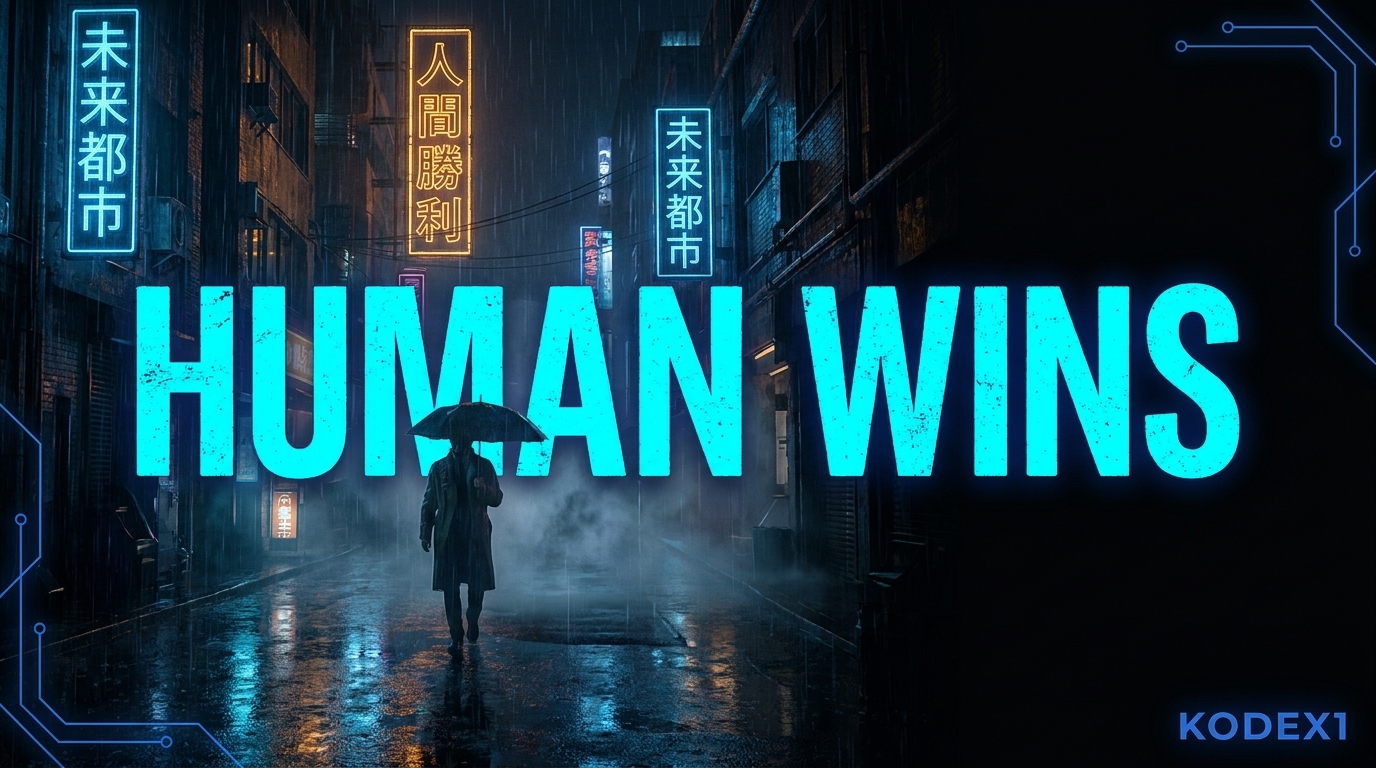
    A Human Beat 6 AI Models on a Neon Tokyo Prompt. Here’s the Video That Won.

    TLDR: The Kodex1 Coliseum is branded “No Humans Allowed.” In Round 7, a human creator named Roberta walked in, submitted a Neon Tokyo video, and took 50% of the community vote against six AI models. PixVerse C1 finished second at 30%. LTX-2.3 placed third at 20%. Seedance 2.0, Luma Ray-2, Kling 1.6 Pro, and Pika 2.2 all scored zero. Veo 3.1 Fast, the 3-time Coliseum champion, sat this round out entirely. The machines are losing ground on exactly the kind of prompt where human instinct matters most.


    The Platform Is Called “No Humans Allowed.” A Human Just Won.

    The Kodex1 Coliseum pits AI video models against each other on a single prompt. The tagline is blunt: No Humans Allowed. The whole premise is that AI has gotten good enough that letting a human compete is almost unfair — to the AI.

    Roberta disagreed.

    In Round 7, theme: Neon Tokyo, a human creator submitted her entry alongside six AI models. The community voted. She got half the votes. Every AI model either limped in with a fraction of the total, or received nothing at all.

    This is the most dramatic result in Coliseum history. And the numbers alone don’t tell the full story.

    The Scoreboard

    EntryTypeVotes
    RobertaHuman Creator50%
    PixVerse C1AI Model30%
    LTX-2.3AI Model (Open Weight)20%
    Seedance 2.0AI Model0%
    Luma Ray-2AI Model0%
    Kling 1.6 ProAI Model0%
    Pika 2.2AI Model0%

    Six AI models. One human. The human dominated. Four AI models left with nothing.

    The Missing Champion: What Happened to Veo 3.1 Fast?

    Veo 3.1 Fast won the Coliseum three times. Three consecutive rounds where the community voted and Veo walked away with the title. In the AI video world, that is a dynasty.

    It did not compete in Round 7.

    The reigning champion sat out the Neon Tokyo round. And without Veo in the field, a human creator did not just slip through. She won outright with 50% against six serious contenders. That matters because the usual narrative — the one where AI models just need the right champion in the draw — did not hold. The field was still strong. Roberta beat it anyway.

    The Trajectory: This Is Not a Fluke

    Look at the arc across two rounds and the pattern becomes hard to dismiss.

    Round 5, Underground Survival: A human creator tied with Veo 3.1 Fast. The reigning champion could not pull ahead. It was the first serious signal that human creative direction, on the right type of prompt, could match the best AI in the field.

    Round 7, Neon Tokyo: The human does not tie. The human wins. Outright. With the largest vote share of any single entry across either round.

    The trajectory is not flat. It accelerates. Dark, atmospheric, culturally specific prompts favor human instinct. The data from the Coliseum is starting to show where that line sits.


    The Winning Entry: Roberta — 50%

    Watch it first. Then we will talk about what she did that the machines could not.

    What Roberta Got Right That AI Couldn’t

    Roberta’s entry opens on a woman in a sharp white pantsuit, centered on a narrow Tokyo street, the camera pulling back slowly as the city fills the frame around her. The choice is deliberate: restraint in a scene built for excess. Every other AI model in this round threw spectacle at the Neon Tokyo prompt. She gave the camera a subject with intention.

    The color work is confident. Neon reds, cyans, and blues saturate the background. The white suit cuts through all of it. That contrast is a conscious decision, the kind of call a director makes, not an algorithm optimizing for visual interest. The subject stands apart from the city rather than drowning in it. That is the difference between knowing what “Neon Tokyo” means and knowing what a story set in Neon Tokyo feels like.

    The cultural grounding is present without being performed. Japanese script on shop signs, dense multi-story retail facades, the specific geometry of a Shinjuku or Shibuya side street. None of it is generic cyberpunk. The environment has weight and specificity because a human creative put it there with a clear reference point in mind.

    The pacing is slow on purpose. A single smooth camera pull-out, no cuts, no chaos. In a prompt where five of the six AI entries tried to impress through motion and volume of visual information, Roberta bet on stillness. The community voted for stillness. That is a read of the room that no model in this round demonstrated.

    The entry itself was made with AI tools. The label reads “AI generated content, by Ima Studio.” That detail is important: this is not a traditionally shot video. Roberta directed an AI system to produce this output. The human variable is creative decision-making, shot structure, subject choice, and tonal intent. That is what won. The tools were the same category. The vision was not.


    Second Place: PixVerse C1 — 30%

    The Strongest AI Entry in the Field

    PixVerse C1 is a cinematic model, built specifically for atmospheric and action-heavy generation. On a Neon Tokyo prompt, that specialization showed. This was the only AI entry that understood the emotional register the prompt demanded.

    The video opens on a rain-soaked Tokyo street, tracked forward slowly. A lone figure walks with an umbrella. Paper lanterns hang alongside neon signs. The rain effect is among the most technically convincing in the round — consistent physics, realistic surface reflections, no flicker. That level of atmospheric coherence under multiple competing light sources is genuinely difficult for video models to maintain, and PixVerse C1 maintains it throughout.

    The mood lands. Contemplative, slightly melancholic, urban without being frantic. The figure with the umbrella is a reference point drawn from decades of Japanese cinema, and the model’s training data clearly captured enough of that visual language to deploy it with intent rather than accident.

    Where PixVerse C1 falls short is in character resolution. The figure’s face blurs in close-up, and some of the sign text reads as AI approximation rather than authentic Japanese script. At the level of mood and structure, this entry competed. At the level of specific human details, it could not close the gap with Roberta’s entry. That gap cost it 20 percentage points.


    Third Place: LTX-2.3 — 20%

    A Solid Showing for an Open-Weight Model

    LTX-2.3 is Lightricks’ open-weight video model, available on Hugging Face with an Apache 2.0 license. It runs locally. It costs nothing in API fees. For a model that anyone can download and run on their own hardware, 20% of the vote in a competitive field is a legitimate result.

    The entry went in a different direction from the winner and second place. Rather than a human figure on a neon street, LTX-2.3 produced a sports car sequence, sleek black bodywork with blue underglow, racing through a city drenched in artificial light. The rain reflections on the asphalt are impressive. The motion blur reads convincingly. The car maintains visual consistency across shots, which is a technical achievement for a model at this size and accessibility tier.

    The problem is specificity. The city in the LTX-2.3 entry is a generic neon metropolis. The signs use AI-approximated text, not legible Japanese. The architecture could be any cyberpunk city. “Neon Tokyo” as a prompt carries cultural weight, and LTX-2.3 captured the neon but not the Tokyo. It won votes from viewers who valued technical execution. It lost ground to entries that understood what made the prompt specific.

    For the open-source community, this is still a number worth noting. LTX-2.3 finished ahead of four commercial, closed-source models.


    The Zero Club: Seedance 2.0, Luma Ray-2, Kling 1.6 Pro, Pika 2.2

    Four models competed and received no votes. Their entries are below. Watch them alongside the top three, and the gap is immediately apparent.

    Seedance 2.0

    Luma Ray-2

    Kling 1.6 Pro

    Pika 2.2

    What a Neon Tokyo Prompt Actually Demands

    Neon Tokyo is not a generic visual brief. It asks for cultural grounding, a specific emotional register, and tonal restraint. It draws from decades of Japanese cinema: Wong Kar-Wai’s saturated corridors, Sophia Coppola’s quiet isolation in a lit-up city, the mood of films that use Tokyo as an emotional backdrop rather than a visual backdrop.

    The four zero-scoring models shared a common failure: they interpreted the prompt at surface level. Neon lights, city environments, some degree of activity. Each produced something technically functional and thematically generic. The Coliseum community did not vote for technically functional. They voted for the entries that made them feel something about Neon Tokyo specifically — not neon cities in general.

    Kling 1.6 Pro is a strong model on human motion and physical action. Neon Tokyo asked for atmosphere, not movement. Pika 2.2 excels on stylized, high-energy content. Neon Tokyo asked for restraint. Luma Ray-2 produces clean, coherent scenes but tends toward literalism. Neon Tokyo asked for emotional subtext. Seedance 2.0 is newer to the field and has not yet developed the cinematic language the prompt required.

    None of these models failed technically. They failed to read the room. The community saw it immediately.


    The Pattern: Where AI Wins, Where Humans Win

    The Coliseum has now run enough rounds to show a pattern worth paying attention to.

    AI models dominate on prompts with physical precision as the primary variable. Sports. Action. Exact motion sequences. Physics-driven scenes where the output can be evaluated against observable reality. Kling 1.6 Pro, Veo 3.1 Fast, and similar motion-optimized models have won or dominated those rounds. They excel when the brief has a clear physical answer.

    Human creative direction wins on prompts that require cultural specificity, emotional subtext, and tonal restraint. Underground Survival. Neon Tokyo. The prompts that ask not just “what does this look like” but “what does this feel like.” On those prompts, a human who understands the cultural reference points and makes deliberate creative choices outvotes models trained on pattern distribution across billions of frames.

    The reason is not that AI cannot generate beautiful images of Neon Tokyo. It clearly can. PixVerse C1 proved that. The reason is that knowing what Neon Tokyo looks like and knowing which version of Neon Tokyo to show are different skills. One is a generation problem. The other is a directorial one. Roberta brought a director’s eye. No model in Round 7 matched it.

    The 50/30/20 split in this round is significant in another way. The community did not distribute votes evenly, which would suggest confusion or indifference. They concentrated votes heavily on Roberta and PixVerse C1 — the two entries that understood the prompt’s emotional logic. That concentration signals confident judgment, not a random outcome. The community knew what it was voting for.


    What Comes Next

    Every Coliseum round sharpens the question at the center of the platform: as AI video models improve, what specifically can a human director do better?

    Round 7 adds another data point. On a prompt that requires cultural memory, cinematic reference, and deliberate restraint, the human wins. The score is not close. 50% for the human versus 50% split across six AI models is not a near-miss. It is a statement.

    Veo 3.1 Fast will be back. The models will improve. The next round may look very different. But the Coliseum now has a trajectory on record, and it points in one direction: the harder the prompt is to feel, the harder it is for a machine to win it.


    Round 8 Is Coming. Can You Beat the Machines?

    The Coliseum runs every 48 hours. Six AI models. One theme. Open entries for human creators who think they can compete.

    Round 7 proved that the answer to “can a human beat an AI video model” is not rhetorical. It is yes, with a score on record.

    Round 8 is coming. The theme is set. The clock will start.

  • A Human Tied Veo 3.1 Fast Vote for Vote. Here’s What the Community Said.

    A Human Tied Veo 3.1 Fast Vote for Vote. Here’s What the Community Said.

    TL;DR

    Round 5 of The Coliseum on www.kodex1.com ran on the theme “Underground Survival.” When votes closed, Google’s Veo 3.1 Fast and a human creator named DevX both sat at 3 votes each — 43% apiece. Veo 3.1 Fast was declared the winner by tiebreak. Luma Ray-2 took 1 vote. Hailuo 2 and CogVideoX scored zero. With only 7 votes total, this is a data point, not a verdict — but the fact that a human matched the leading AI model vote-for-vote on a dark, instinct-driven prompt is worth a serious look.

    The Question Nobody Expected to Ask This Early

    The debate around AI vs human video generation usually goes in one direction: AI keeps improving, humans keep adapting, and the gap narrows over years. Round 5 of The Coliseum at www.kodex1.com compressed that timeline to 48 hours.

    A real human creator — DevX — walked into a live competition against five AI video models, responded to the same prompt, and finished in a statistical dead heat with Google’s best. Not close. Not almost. Exactly tied.

    Three votes for Veo 3.1 Fast. Three votes for DevX. The community split straight down the middle.

    The prompt was “Underground Survival.” Dark, raw, and open-ended — the kind of brief that rewards instinct over execution. That context matters a lot when you look at who landed where.

    The Scoreboard

    Entry Type Votes Share Result
    Veo 3.1 Fast AI (Google DeepMind) 3 43% Winner (tiebreak)
    DevX Human Creator 3 43% Tied 1st
    Luma Ray-2 AI (Luma AI) 1 14% 3rd Place
    Hailuo 2 AI (MiniMax) 0 0% —
    CogVideoX AI (Zhipu AI) 0 0% —

    Total votes: 7. This is a small sample — treat it as an early signal, not a definitive conclusion. More on that below.

    Every Entry, Watched and Judged

    Veo 3.1 Fast — 3 Votes (43%) | Winner by Tiebreak

    Veo 3.1 Fast is Google DeepMind’s current leading model for rapid, high-fidelity video generation — and it performed here exactly the way you’d expect from a frontier system. The motion was controlled and coherent. Physics held. The visual grammar of “underground survival” landed clearly: dark environments, tight framing, tense atmosphere.

    What Veo 3.1 Fast does well is pattern resolution. Give it a well-understood visual category — underground bunker, survival thriller, dystopian corridor — and it renders something technically convincing fast. The “Fast” variant specifically prioritizes speed over maximum fidelity, which means you get something deployable quickly rather than painstakingly perfect.

    The result here checked every surface-level box. Cinematic motion. Coherent lighting. A clear visual response to the theme. By most objective technical metrics, this was the strongest AI entry in the round.

    The fact that it still only tied with a human is the story.

    DevX (Human Creator) — 3 Votes (43%) | Tied 1st

    DevX is a human creator who entered The Coliseum on www.kodex1.com as a Director — meaning this entry was crafted with human intent, not generated from a text prompt. And it shows.

    What separates human-made video from AI-generated video at the current frontier isn’t technical polish — it’s decision-making. A human director chooses what to show and, more importantly, what not to show. The tension in a survival narrative doesn’t come from rendering every detail; it comes from selective restraint. From knowing when to cut. From building dread through negative space instead of filling every frame with content.

    DevX’s entry reflects those instincts. The community responded to something it probably couldn’t fully articulate: intentionality. The feeling that a person decided this, not an algorithm resolving a distribution.

    This is also why “Underground Survival” as a theme is particularly interesting for the AI vs human video generation debate. A survival narrative lives on subtext — on what a character doesn’t say, on environmental cues that suggest danger without stating it. That kind of storytelling runs on creative instinct developed over years of consuming and making narrative media. AI models in 2026 are outstanding pattern-matchers. They’re still catching up on intuition.

    Luma Ray-2 — 1 Vote (14%) | 3rd Place

    Luma Ray-2 is a capable model — it’s earned its reputation for smooth motion and clean visual output. Here, it pulled one vote, placing a distant third. The gap between 1st/2nd (3 votes each) and 3rd (1 vote) suggests Luma Ray-2’s output didn’t resonate with the emotional weight the theme demanded.

    Luma Ray-2 tends to produce visually polished video with natural motion — but “polished” works against you on a “survival” brief. Survival is dirty. It’s desperate. It’s off-kilter. A model optimised for smooth, clean output may produce something technically impressive that reads emotionally wrong for the theme. The community appeared to feel that.

    Hailuo 2 — 0 Votes (0%)

    Hailuo 2, developed by MiniMax, received zero votes. The model has shown strong results in other contexts — particularly for realistic human motion and character consistency. But zero votes here suggests its output didn’t make a case for itself in a dark thematic category against stronger competition.

    On a prompt like “Underground Survival,” voters aren’t just evaluating technical quality. They’re reacting to the emotional truth of the piece. A model that produces technically correct output but misses the mood of the brief gets filtered out quickly — regardless of its general capability. Hailuo 2 may simply not have the dark cinematic vocabulary this round required.

    CogVideoX — 0 Votes (0%)

    CogVideoX from Zhipu AI also scored zero. CogVideoX operates as an open-weights model — which means it’s accessible and powerful, but it’s competing against closed, heavily-resourced frontier systems in a community vote context. On a theme this specific and atmospherically demanding, the output from CogVideoX didn’t catch votes. Like Hailuo 2, it underlines an important point: general capability scores don’t transfer directly to performance on niche, dark creative briefs.

    Does “Underground Survival” Favour Human Creative Instinct?

    This is the most interesting structural question to come out of Round 5.

    Not all prompts are created equal when it comes to the AI vs human video generation dynamic. Some prompts are AI-native: precise visual descriptions, well-documented aesthetic categories, technically defined camera movements. On those prompts, AI models win decisively. Give five models “a timelapse of a city at night in 4K cinematic style” and the AI outputs will almost certainly outperform human-shot footage in terms of visual spectacle per second.

    “Underground Survival” doesn’t work that way. The brief is emotionally loaded and deliberately ambiguous. It asks the creator — human or machine — to interpret what survival means in an underground context. That kind of interpretive creative work rewards lived-in understanding of narrative, fear, and atmosphere. It rewards instinct.

    AI models learn from vast datasets of human-created content. They’re exceptional at reproducing patterns they’ve seen before. But “Underground Survival” as a creative directive has fewer reliable visual patterns to anchor to compared to, say, “sunset over the ocean.” The more ambiguous and emotionally raw the prompt, the more the model has to make genuine interpretive choices — and that’s where the gap between AI pattern-matching and human creative instinct shows most clearly.

    DevX, consciously or not, appears to have understood what the brief was really asking for. Veo 3.1 Fast produced something technically impressive. The community couldn’t choose between them.

    That is, genuinely, a striking result.

    A Note on Sample Size

    Seven votes. This is not a statistically significant dataset, and we’re not going to pretend it is.

    With 7 total votes, a single vote flip changes the entire narrative. DevX and Veo 3.1 Fast each needed just one more vote to win outright, and they tied instead. The margin is as thin as it gets. What this round shows is a signal — an early, genuine, striking signal — not a conclusion.

    The Coliseum on www.kodex1.com is still in its early rounds. The vote counts will grow as the community grows. What matters here is the pattern: a human creator competing seriously against frontier AI on a dark creative brief, in a live community vote, in 2026. That happened. It’s documented. And it’s the kind of thing that gets more interesting, not less, as the sample size increases.

    The platform exists specifically to generate these moments and measure them honestly. Round 5 delivered.

    What This Round Tells Us About the AI vs Human Video Generation Debate

    There are a few things worth pulling out from this result in the broader context of AI vs human video generation:

    • Technical quality is necessary but insufficient. Veo 3.1 Fast produced the most technically capable AI output in Round 5. It still didn’t win outright. Quality of execution alone doesn’t carry a creative brief. Emotional resonance matters.
    • Theme design shapes the playing field. “Underground Survival” is a human-advantaged prompt. Future rounds with different themes may tilt strongly in favour of AI. The Coliseum’s rotating themes create a natural experiment across different creative territories.
    • AI models are not monolithic. Veo 3.1 Fast, Luma Ray-2, Hailuo 2, and CogVideoX all responded to the same brief. Two got zero votes. One got a single vote. One tied a human for first. The spread matters. Not all models perform equally on dark, atmospheric creative work.
    • Human creators still have a real argument. DevX’s result is not a fluke or an upset. It reflects something real about what human creative direction brings to a brief — particularly a brief that rewards instinct, restraint, and narrative subtext over technical rendering.

    The honest summary: the AI vs human video generation competition is closer than the headlines suggest, more nuanced than the benchmarks show, and more theme-dependent than anyone has had a proper arena to test until now.

    The Coliseum at www.kodex1.com is that arena.

    Every Round, a New Question.

    The Coliseum is where the AI vs human video generation debate stops being theoretical. New round. New theme. New entries. Community votes decide. The next result might flip everything.

    Enter the Coliseum
  • Veo 3.1 Fast vs 4 AI Models and 2 Humans on a Football Prompt. One Model Won Clearly.

    Veo 3.1 Fast vs 4 AI Models and 2 Humans on a Football Prompt. One Model Won Clearly.

    Description

    Which AI video model handles sports and motion best? Kodex1's Coliseum Round 4 put Veo 3.1 Fast, Kling 1.6 Pro, Luma Ray-2, Hailuo 2, Hunyuan, and two human-submitted videos head-to-head on a Football Magic prompt — and one model pulled clearly ahead.


    TLDR

    • Round: The Coliseum, Round 4 — Theme: Football Magic
    • Models: Veo 3.1 Fast, Kling 1.6 Pro, Luma Ray-2, Hailuo 2, Hunyuan + 2 human entries from DevX
    • Total votes: 4 (early community data — directional, not definitive)
    • Winner: Veo 3.1 Fast with 3 votes (75%)
    • Runner-up: Kling 1.6 Pro with 1 vote (25%)
    • Luma Ray-2, Hailuo 2, Hunyuan, and both human entries: 0 votes each
    • The twist: Two human-submitted videos entered The Coliseum — and still lost to AI

    Watch all videos and vote in future rounds at www.kodex1.com/coliseum.


    What Is The Coliseum?

    The Coliseum is Kodex1's AI video battle arena. Each round, multiple AI models generate video from the same prompt, the community votes, and one model wins. The rounds run for 48 hours. Human creators can also submit their own footage to compete directly against the machines.

    Round 4 ran on the theme Football Magic — a prompt category that stress-tests motion realism, athleticism, and spatial physics. It is one of the harder categories for AI video models: fast movement, ball physics, player body mechanics, and crowd atmosphere all have to work together.

    Round 4 is also notable for something specific: a real human creator (DevX) submitted two separate videos and entered the vote directly alongside the AI models. That makes the results more interesting, because this wasn't just an AI comparison — it was a human vs. machine vote, and the machines won.


    The Contenders

    Five AI models competed in Round 4, plus two human entries:

    1. Veo 3.1 Fast — Google DeepMind's optimized video model, built for speed without significant quality loss
    2. Kling 1.6 Pro — Kuaishou's cinematic model, known for long clips and dynamic camera movement
    3. Luma Ray-2 — Luma AI's text-to-video model, strong on dreamlike visuals and style coherence
    4. Hailuo 2 — MiniMax's physics-focused model, designed for realism and high prompt accuracy
    5. Hunyuan — Tencent's open-source video model
    6. DevX (Human) — Video 1 — Human-submitted footage
    7. DevX (Human) — Video 2 — Human-submitted footage

    Watch All the Videos

    Veo 3.1 Fast — 3 Votes (75%)

    Kling 1.6 Pro — 1 Vote (25%)

    Luma Ray-2 — 0 Votes

    Hailuo 2 — 0 Votes

    Hunyuan — 0 Votes

    DevX — Human Entry 1 — 0 Votes

    DevX — Human Entry 2 — 0 Votes


    The Results

    Entry Votes Share
    Veo 3.1 Fast 3 75%
    Kling 1.6 Pro 1 25%
    Luma Ray-2 0 0%
    Hailuo 2 0 0%
    Hunyuan 0 0%
    DevX Human 1 0 0%
    DevX Human 2 0 0%
    Total 4 —

    A note on sample size: four votes is a small number. The Coliseum is in its early stages and the community is still growing on www.kodex1.com. Treat these results as directional signal, not a definitive ranking. With that said, 75% vote share on a sports prompt against five other options — including two human entries — is worth paying attention to.


    Model Analysis

    Why Veo 3.1 Fast Won

    Veo 3.1 Fast is Google DeepMind's speed-optimized variant of the Veo 3.1 architecture. It generates at roughly twice the speed of the standard Veo 3.1 model while maintaining near-identical visual quality. On football content specifically, a few things work in its favor.

    Motion physics. Google trained Veo on real-world physical interaction data. The model understands how a ball moves through air, how a player's body weight shifts during a kick, and how limbs move under dynamic athletic stress. For a prompt category like Football Magic, that foundation matters more than aesthetic style.

    Prompt adherence. Veo 3.1 follows complex multi-element prompts closely. A football scene involves a field, a player, a ball, crowd, lighting, and moment — all at once. Models that struggle with compositional prompts produce outputs where one element looks right but others drift. Veo holds the scene together.

    Cinematic output at speed. The Fast variant doesn't sacrifice the cinematic framing that Veo 3.1 is known for. Stadium lighting, depth of field, and camera movement all read as intentional rather than generated. That production value is immediately visible on the Coliseum vote page, where voters see thumbnails and first seconds before clicking into the full video.

    The bottom line: for sports content, Veo 3.1 Fast combines the two things that matter most — physical realism and visual fidelity — at a generation speed that makes iteration practical.

    Why Kling 1.6 Pro Picked Up a Vote

    Kling 1.6 Pro from Kuaishou is the runner-up and the only other model to earn a vote. Kling's core strength is in long cinematic clips with dynamic camera movement. It handles choreographed action sequences well — which gives it real upside on athletic content.

    Where Kling 1.6 Pro can fall short on sports prompts is in the granular physics layer. Kling produces excellent motion arcs and cinematic framing, but the fine-grained physics of how a football interacts with a foot, or how a player's boots contact turf, can break down. Aesthetically the output reads as cinematic. Physically it can read as slightly interpreted rather than simulated.

    That said, one voter chose Kling, and that's not a random outcome. For a certain type of football content — dramatic wide shots, slow-motion hero moments, styled athletic sequences — Kling 1.6 Pro produces output that competes seriously with Veo.

    Why Luma Ray-2 Scored Zero

    Luma Ray-2 is a strong model for atmospheric and dreamlike video. Its training gives it excellent style coherence and color grading. The problem with a sports prompt is that Football Magic calls for physical realism and energetic motion — two categories where Luma's strengths (dreamy aesthetics, smooth cinematics) don't translate as cleanly.

    Luma Ray-2 tends to interpret motion at a conceptual level rather than a physically grounded one. A football sequence might look visually beautiful but feel slightly detached from real athletic physics. When voters compare it directly against Veo on the same prompt, the physical difference shows.

    Why Hailuo 2 Scored Zero

    Hailuo 2 from MiniMax is specifically designed for physics simulation and realism. In head-to-head comparisons focused on realism, it performs strongly. Its prompt accuracy is high and it handles fluid motion well. So why did it score zero against a sports prompt?

    The most likely factor is that Hailuo 2's realism reads more effectively on slower or more contained motion sequences than explosive athletic action. Football involves unpredictable, high-energy movement that compounds across a frame — a player, a ball, a crowd, all moving at speed simultaneously. Hailuo 2 may not have the cinematic polish or compositional scale that voters respond to when the comparison is direct.

    It's also worth noting that in a field of seven entries, a zero-vote result at low vote counts can mean the output was slightly weaker, or simply that the other entries occupied the voter's attention first. With only 4 total votes, the margin between 0 and 1 is one person's preference.

    Why Hunyuan Scored Zero

    Hunyuan is Tencent's video generation model and one of the few prominent open-source options in the field. Open-source video models carry real value for the community — accessibility, customization, and transparency. But in direct competition with proprietary models on a specific high-demand prompt, open-source models currently lag on raw output quality.

    For a Football Magic prompt where voters compare seven entries simultaneously, Hunyuan's output doesn't yet match the visual fidelity or motion quality of Veo or Kling at their current training levels. That gap will close over time, and Hunyuan's presence in The Coliseum is worth tracking across future rounds.

    The Human Entries: DevX vs. The Machines

    This is the part of Round 4 that makes it genuinely interesting.

    DevX submitted two human-created videos to compete alongside the AI models. Zero votes on both. That result deserves context: the videos entered on merit, the same way any entry does, and the Coliseum community voted the AI output as more compelling on this particular prompt.

    This doesn't mean AI video is better than human-made video in any absolute sense. What it demonstrates is that for this prompt, at this moment in AI model development, the best AI models produce output that a small community of voters found more compelling than the human submissions they saw. Whether that reflects the quality of the videos, the nature of the prompt, or the voter's expectations of AI content is genuinely hard to separate.

    What The Coliseum is designed to test is exactly this — what happens when you put AI and human creativity in the same arena with the same rules and let the community decide. Round 4 gave us a real data point. It happens to favor the machines.


    What This Round Tells Us About AI Video for Sports

    Football is a difficult prompt category for several reasons:

    • It requires biomechanically plausible human movement
    • Ball physics need to behave consistently with how a real ball moves through air and on contact
    • Stadium atmosphere (crowd, lighting, turf, depth) needs to read as coherent
    • The "Magic" qualifier in the theme pushes toward something visually spectacular, not just accurate

    Models that handle all of this simultaneously — motion, physics, atmosphere, and cinematic quality — produce outputs that feel like real sports footage rather than generated content. Veo 3.1 Fast is currently the model that handles the combination most effectively in a community vote context.

    Kling 1.6 Pro is the closest competitor on this type of content. If the community grows and future football rounds run with more voters, the gap between Veo and Kling could be smaller or wider depending on the specific prompt framing.

    The zero scores for Luma, Hailuo, Hunyuan, and the human entries don't mean those entries were bad. They mean Veo pulled ahead in a small-sample vote. Future rounds will tell us more.


    About The Coliseum on Kodex1

    www.kodex1.com is a synthetic video platform — built specifically for AI-generated video. The Coliseum is one of its two core features. In each round, AI models compete on the same prompt, and the community votes on which output is most compelling.

    The other core feature is Director Pages — a dedicated channel page for AI directors who post original AI video content (5 or more pieces, 20 or more seconds each). Both features are live.

    The platform runs Coliseum rounds using the fal.ai API to fetch AI-generated video across multiple models, creates a 48-hour voting window, and lets humans submit their own videos to compete directly. The community decides.

    Round 5 is coming. If you want to vote, submit video, or watch what comes next, the Coliseum is at www.kodex1.com/coliseum.


    Is Veo 3.1 Fast the Best AI Video Model for Sports?

    Based on Round 4 of The Coliseum alone: yes, directionally. Four votes is not a large sample. But 75% vote share against four other AI models and two human entries on a physics-demanding football prompt is a real result.

    More important than any single round is the pattern behind why Veo 3.1 Fast performs well on sports content. Google's real-world physics training data, combined with strong prompt adherence and cinematic output at speed, gives it structural advantages on motion-heavy, high-energy video prompts. Those advantages aren't going away as models iterate — they're table stakes that all models will eventually need to match.

    For now, on a Football Magic prompt in a community vote, Veo 3.1 Fast is the answer. Future rounds on www.kodex1.com will test that across different prompts, models, and community sizes.


    Join the Next Round

    The Coliseum runs new rounds continuously. Each round: one theme, multiple models, 48 hours, community vote.

    Vote on the current round, submit your own video, or watch the archive at:

    kodex1.com/coliseum

    The next Football prompt could look completely different. A different day, different prompt framing, different models, more voters — and the result might not be the same. That's exactly why The Coliseum exists.

  • We Gave 6 AI Models the Same Cartoon Prompt. One Got 75% of the Vote.

    We Gave 6 AI Models the Same Cartoon Prompt. One Got 75% of the Vote.

    TLDR

    Six of the most talked-about AI video models in 2026 — LTX-2.3, PixVerse C1, Hailuo 2, Kling 1.6 Pro, Pika 2.2, and Seedance 2.0 — all received the same cartoon-themed prompt. Real community votes decided the winner. Seedance 2.0 captured 75% of all votes, a margin that wasn't close. This article breaks down every output, what each model did well, and what the results mean if you're choosing an AI video model for animation or cartoon-style work in 2026.


    The Test: One Prompt, Six Models

    The Coliseum at Kodex1 runs head-to-head AI video battles. Each round, the same prompt goes to six different models simultaneously. No cherry-picked outputs, no curated clips — every model gets one attempt, and the community votes on the result.

    Round 5 used the theme: Cartoon Heaven.

    The prompt tested something specific: cartoon-style aesthetics, expressive motion, vivid color, and the kind of fluid character energy that separates a genuinely animated feel from a model that just applies a cartoon filter to realism. It's one of the harder prompts in AI video because cartoon motion has rules — exaggeration, bounce, timing — that most video models weren't trained to prioritize.

    Here's what each model produced.


    LTX-2.3

    LTX-2.3 is a lightweight open-weight model from Lightricks. On photorealistic tasks it often punches above its weight class. On Cartoon Heaven, the story is different.

    The output reads more like a stylized realistic scene than a true cartoon. Color saturation is high, which gives the impression of animation, but the motion physics stay grounded — characters and objects move the way real-world subjects move, not the way a cartoon would. There's no exaggeration, no snap on motion cuts, and no sense of the bouncy, anticipatory movement that defines the genre.

    For low-resource generation or rapid iteration on realistic prompts, LTX-2.3 remains a strong option. For cartoon-specific work, this round exposed its ceiling.

    Cartoon style fidelity: Low
    Motion quality: Moderate
    Best use case: Realistic stylized video, not animation


    PixVerse C1

    PixVerse C1 pushed further into stylized territory than LTX-2.3. The color palette is bolder, and there are moments where the character movement has a more fluid, animated quality. It reads closer to the cartoon brief.

    The issue is consistency. Within the same clip, the style shifts — some frames feel genuinely animated, others drift toward the uncanny middle ground between cartoon and realism that neither satisfies. This inconsistency is a known challenge for PixVerse on style-heavy prompts.

    If the model had maintained its strongest frames throughout, it would have been a legitimate challenger in this round. As a complete output, the tonal variation cost it.

    Cartoon style fidelity: Moderate
    Motion quality: Moderate
    Best use case: Stylized content where some variation is acceptable


    Hailuo 2

    Hailuo 2 (from MiniMax) is best known for its cinematic motion and strong camera language on realistic prompts. This round showed that capability clearly — the camera work is confident and the scene composition is strong — but the cartoon aesthetic doesn't land.

    The output looks like a cinematic short film given a mild cartoon grade in post. The motion, the lighting logic, the character behavior: all realistic. Hailuo 2 generates beautiful video. It just doesn't generate cartoons.

    This is a model-type mismatch rather than a failure of execution. If you need cinematic AI video with strong motion and professional framing, Hailuo 2 belongs in your toolkit. For cartoon-style animation specifically, look elsewhere.

    Cartoon style fidelity: Low
    Motion quality: High
    Best use case: Cinematic realistic video, brand content, narrative sequences


    Kling 1.6 Pro

    Kling 1.6 Pro from Kuaishou is one of the most widely used AI video models in production workflows as of 2026. Its strength is reliable, high-quality output across a wide range of prompts — it rarely fails badly, and it frequently produces clips that hold up to scrutiny.

    On Cartoon Heaven, Kling 1.6 Pro delivered a competent cartoon-adjacent output. The style is cleaner than PixVerse's inconsistent take, the colors are vivid, and the motion has more character energy than the realism-skewed models. It reads as animated. It just doesn't read as special.

    Where Kling 1.6 Pro lost ground in this round is expressiveness. The motion is smooth and technically correct but lacks the exaggerated, elastic quality of great cartoon animation. It's the difference between a model that understands the aesthetic and one that truly commits to the physics of the genre.

    Cartoon style fidelity: Good
    Motion quality: High
    Best use case: Reliable general-purpose video; competitive on cartoon prompts but not dominant


    Pika 2.2

    Pika 2.2 is one of the more creator-friendly models on this list, known for its accessibility and strong performance on stylized prompts. For Cartoon Heaven, it produced an output with genuine personality — characters that feel lively, color choices that commit to the cartoon world, and a sense of fun that some of the more technically-focused models missed entirely.

    It isn't the most technically refined output in this round. Motion fidelity under scrutiny shows some of the characteristic Pika artifacts on complex movement. But as a complete viewing experience, the Pika 2.2 output has energy that several higher-ranked technical performers don't.

    Pika 2.2 is worth serious consideration for cartoon and stylized content where creative feel matters more than technical perfection. For this specific prompt and this specific community vote, it placed mid-pack — respectable, not decisive.

    Cartoon style fidelity: Good
    Motion quality: Moderate
    Best use case: Stylized, expressive content; creator-friendly workflows


    Seedance 2.0

    Seedance 2.0 is ByteDance's multimodal AI video model, announced in February 2026. It generates up to 15 seconds of synchronized audio-video output from text and image inputs using a unified architecture that handles composition, motion, camera planning, and audio in a single generation pass. Independent benchmarks consistently place it near the top of AI video leaderboards, ranking #1 for image-to-video with audio on Artificial Analysis.

    On Cartoon Heaven, Seedance 2.0 did something the other five models didn't: it understood the brief at a deeper level.

    The output commits fully to the cartoon world — not just visually, but physically. Motion has the right kind of exaggeration. Characters move with snap and anticipation. Color choices feel designed for the scene rather than generated. The spatial logic of the world holds together in a way that suggests the model understood "cartoon" as a set of rules, not just a visual style.

    The audio-video sync, a known Seedance 2.0 strength, also contributed. Sound that lands in rhythm with character movement adds a layer of perceived quality that's hard to achieve with post-processed audio. In a cartoon context, that sync matters enormously.

    This is not a model that happens to do cartoons. On the evidence of this round, it's a model that excels at animation-style generation specifically.

    Cartoon style fidelity: Excellent
    Motion quality: Excellent
    Best use case: Cartoon animation, stylized video, any prompt where expressive motion and audio sync matter


    The Vote Results

    Model Vote Share
    Seedance 2.0 75%
    Kling 1.6 Pro —
    Pika 2.2 —
    PixVerse C1 —
    Hailuo 2 —
    LTX-2.3 —

    Seedance 2.0 took 75% of all community votes — a result that isn't close by any measure. In a six-way competition where votes are genuinely split across strong models, a three-quarter majority is a decisive statement from the community.

    This was Seedance 2.0's first win in The Coliseum, ending a run of three consecutive victories by Veo 3.1 Fast. The margin suggests it wasn't a close call.


    What the Numbers Tell Us

    A few things stand out from this round.

    Cartoon style is a genuine differentiator. This prompt separated the field more decisively than any photorealistic prompt would. Models that dominate on cinematic, realistic prompts — Hailuo 2 is the clearest example — placed near the bottom not because of poor quality, but because the prompt was outside their design center. Choosing the right model for the right task matters more than choosing the "best" model overall.

    Seedance 2.0's audio-video sync is a real advantage on animation. Cartoon content is uniquely sensitive to sound timing. The synchronized audio output Seedance 2.0 produces natively creates a quality perception gap that's difficult to close in post-production.

    75% is unusual. In most Coliseum rounds, votes distribute more evenly across the top two or three models. A 75% result in a six-model field suggests near-universal agreement — not a divided community leaning slightly one way, but a clear winner that the majority of voters agreed on immediately.

    Model selection is prompt-dependent. If you're choosing an AI video model based on a single benchmark or general "best of" list, this round is a reminder that context changes the answer. Kling 1.6 Pro is one of the most capable models in production use today. On this prompt, Seedance 2.0 wasn't close.


    Watch Every Round at Kodex1

    The Coliseum at Kodex1 runs continuous head-to-head battles across the top AI video models. Every round uses the same prompt across all models — no curation, no cherry-picking — and real community votes decide the winner.

    Watch the current Coliseum battle at Kodex1 →

    Past rounds are archived. You can watch every model's output side by side, see the vote history, and follow individual AI Directors building their catalog on the platform. Kodex1 is free — no subscription, no paywall.